
500 Tph Gold Mining Washing Plant Fabricators Bulk Order


500 TPH Gold Mining Washing Plant Fabricators: HighCapacity Bulk Order Solutions
The Operational Challenge: When Your Throughput Target Becomes a Bottleneck
For midtier and largescale gold mining operations, the gap between runofmine (ROM) feed and recoverable gold is where profitability is won or lost. When your current washing circuit caps out at 300 TPH, every additional hour of operation represents lost revenue. Consider these figures from recent industry benchmarks:
- Downtime costs: A 12hour unscheduled stoppage at a 500 TPH operation can represent $150,000–$250,000 in lost processing capacity, depending on ore grade.
- Feed inconsistency: Claybound ore, highmoisture content, and oversized rock can reduce washing efficiency by 20–35% in underspecification plants.
- Water management: Inefficient washing circuits consume 30–50% more water per ton processed, driving up both operational costs and environmental compliance burdens.
- Labour overhead: Manual sorting and recirculation tasks add 4–6 additional operators per shift, increasing annual payroll by $180,000–$300,000.
- Suitable for: Alluvial gold, weathered saprolite, and placer deposits with clay content up to 40%.
- Limitations: Not designed for primary hardrock crushing; requires precrushing if feed exceeds 300mm. Recovery efficiency decreases for gold particles finer than 75 microns without additional leach or flotation circuits.
- Coldweather package: Insulated cabins, heated water lines, and lowtemperature lubricants (+$85,000)
- Remote monitoring system: Satellitebased telemetry for fleetwide performance tracking (+$45,000)
- Dualpower configuration: Electric/diesel hybrid drive for sites with unstable grid power (+$120,000)
- Preventive Maintenance Contract: Quarterly inspections, wear part replacement, and priority technical support (from $18,000/month)
- Performance Audit: Annual plant audit with recovery testing and optimization recommendations ($25,000 per audit)
- Leasetoown: 36–60 month terms with a 10% residual value
- Deferred payment: 30% down payment, 40% on delivery, 30% after successful commissioning
- Performancebased financing: Payment tied to achieved throughput and recovery milestones (available for qualified buyers)
The question is not whether you need a 500 TPH gold washing plant—it is whether your fabricator can deliver a system that maintains recovery rates above 95% while handling the specific clay and rock conditions of your site. Can your current equipment keep pace with your mine plan? If not, the solution lies in a purposebuilt, highcapacity washing plant designed for bulk deployment.
Product Overview: The 500 TPH Modular Gold Washing Plant
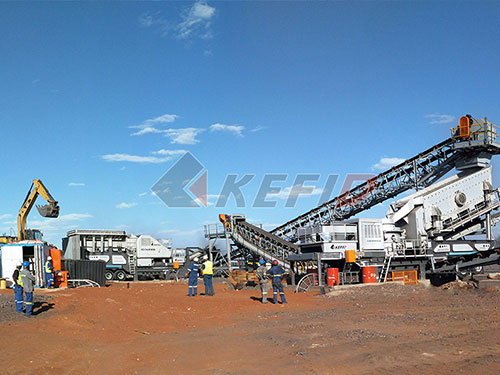
This equipment is a highcapacity, modular gold washing system designed for alluvial, eluvial, and weathered hardrock gold deposits. It integrates scrubbing, screening, and gravity concentration into a single continuous process, engineered for rapid onsite assembly and relocation.
Operational Workflow (5Step Process)
1. Feed Hopper & Grizzly: ROM material is loaded into a heavyduty feed hopper with a vibrating grizzly (100mm aperture) to scalp oversize rock, directing it to a waste conveyor.
2. Rotary Trommel Scrubbing: Material enters a 2.4m diameter x 8.0m long trommel with highpressure water jets (10–12 bar) to break down clay agglomerates and liberate gold particles.
3. Screening & Classification: The trommel screen (6mm and 20mm interchangeable panels) separates the slurry from oversize rejects. The undersize fraction reports to the concentrator feed.
4. Gravity Concentration: The slurry is distributed to a bank of centrifugal concentrators (e.g., Knelson or Falcon type) and a downstream shaking table for fine gold recovery.
5. Tailings Management: Processed slurry is directed to a dewatering screen and settling pond system, with clarified water recycled back to the plant.
Application Scope
Core Features: Engineering for Continuous HighVolume Output
HighCapacity Rotary Trommel | Technical Basis: Variablespeed drive (0–12 RPM) with replaceable polyurethane screen panels | Operational Benefit: Handles 500 TPH of sticky, claybound feed without blinding, maintaining consistent screening efficiency | ROI Impact: Reduces recirculation load by 25%, lowering energy consumption by 15% per ton processed
DualShaft Paddle Scrubber | Technical Basis: Counterrotating paddles with adjustable angle (15–30 degrees) create high attrition force | Operational Benefit: Achieves 98% clay disintegration in under 3 minutes of retention time, even for kaoliniterich ores | ROI Impact: Eliminates the need for a separate presoak tank, saving $40,000–$60,000 in auxiliary equipment costs
HighPressure Water Injection System | Technical Basis: 12bar centrifugal pumps with 20mm nozzles arranged in a spiral pattern | Operational Benefit: Optimizes watertosolid ratio (1.5:1) for maximum gold liberation without oversaturating the slurry | ROI Impact: Cuts water consumption by 30% compared to standard systems, reducing pumping and settling costs
Modular Frame Construction | Technical Basis: Bolted, prefabricated steel modules (ISO container dimensions) | Operational Benefit: Reduces onsite installation time to 10–14 days with a 6person crew, no welding required | ROI Impact: Saves 3–4 weeks of project schedule, translating to $200,000–$350,000 in earlier production revenue

Integrated Slurry Distribution System | Technical Basis: Hydraulic cyclone manifold with adjustable vortex finders | Operational Benefit: Ensures even feed distribution to multiple concentrators, preventing overload or starvation | ROI Impact: Increases overall gold recovery by 3–5% through consistent mass flow control
Automated Control Panel | Technical Basis: PLCbased system with HMI touchscreen, monitoring vibration, bearing temperature, and motor amperage | Operational Benefit: Provides realtime diagnostics and alarm notifications, enabling predictive maintenance | ROI Impact: Reduces unplanned downtime by 20% and extends component lifespan by 18 months
HeavyDuty Skid Mounting | Technical Basis: Reinforced Ibeam skids with 4point lifting lugs | Operational Benefit: Facilitates rapid relocation between pits or sites using standard lowbed trailers | ROI Impact: Reduces mobilization costs by 40% compared to fixed installations
Competitive Advantages: Performance Benchmarking
| Performance Metric | Industry Standard (400–450 TPH) | 500 TPH Solution | Advantage (% Improvement) |
| : | : | : | : |
| Throughput Capacity | 400–450 TPH | 500–550 TPH (peak) | +11–22% |
| Clay Disintegration Rate | 85–90% in 5 min | 98% in 3 min | +8–13% efficiency |
| Water Consumption | 2.0–2.5 m³/ton | 1.5 m³/ton | 25–40% water usage |
| Gold Recovery Rate (gravity) | 85–92% | 93–96% | +4–8% recovery |
| Setup Time (onsite) | 21–28 days | 10–14 days | 50% installation time |
| Availability (uptime) | 85–90% | 95–97% | +5–7% operational uptime |
| Energy Consumption | 0.8–1.0 kWh/ton | 0.65 kWh/ton | 19–35% energy cost |
Technical Specifications
| Parameter | Specification |
| : | : |
| Model | GW500 |
| Nominal Capacity | 500 TPH (bulk density 1.6 t/m³) |
| Max Feed Size | 300mm (after grizzly scalping) |
| Trommel Dimensions | Ø2.4m x 8.0m |
| Screen Media | Polyurethane panels, 6mm / 20mm / 50mm options |
| Scrubber Type | Dualshaft paddle, 2 x 75 kW motors |
| Water Requirement | 750 m³/h at 10–12 bar |
| Installed Power | 450 kW (total connected load) |
| Concentrator Capacity | 2 x 250 TPH centrifugal concentrators |
| Tailings Dewatering | 2.4m x 6.0m dewatering screen (0.5mm cut) |
| Dimensions (L x W x H) | 28m x 8m x 6.5m (assembled) |
| Weight | 145 tons (dry, excluding conveyors) |
| Operating Temperature | 10°C to +50°C (with coldweather package option) |
| Noise Level | ≤ 85 dB(A) at 1m (with acoustic enclosures) |
Application Scenarios: FieldProven Results
LargeScale Alluvial Mine in West Africa | Challenge: The site had 35% clay content and high seasonal rainfall, causing frequent screen blinding and reducing throughput to 320 TPH. | Solution: Deployment of the 500 TPH washing plant with a highpressure water system and dualshaft scrubber. | Results: Throughput stabilized at 480–510 TPH; gold recovery increased from 88% to 94%; water recycling reduced freshwater intake by 40%, enabling operation through the dry season.
Contract Mining Operation in South America | Challenge: The contractor needed to process 2 million tons of weathered ore within a 6month window, with frequent site relocations. | Solution: The modular design allowed for two complete relocations with 12day setup periods each. | Results: The project was completed 3 weeks ahead of schedule; the client achieved a 15% reduction in costperton processed compared to their previous fixed plant.
HardRock Tailings Retreatment Project in Australia | Challenge: Reprocessing old tailings with high fines content (75µm) and residual gold values. | Solution: The plant was configured with a finer screen (6mm) and additional centrifugal concentrators to capture fine gold. | Results: Recovery of an additional 0.4 g/t gold from tailings; the project achieved a payback period of 11 months based on gold price at the time.
Commercial Considerations for Bulk Orders
Pricing Tiers (Indicative, FOB Port of Loading)
| Configuration | Includes | Price Range (USD) |
| : | : | : |
| Standard Package | Complete washing plant, 50m of interconnecting conveyors, control panel, 12month spare parts kit | $1.8M – $2.2M |
| Enhanced Package | Standard + integrated water treatment system, additional 100m conveyors, operator training (2 weeks onsite) | $2.4M – $2.8M |
| Turnkey Package | Enhanced + site installation supervision, commissioning, 6month onsite service engineer, performance guarantee | $3.0M – $3.5M |
Optional Features
Service Packages
Financing Options
FAQ: Addressing Your Key Concerns
1. Can this plant handle ore with high clay content (above 40%)?
Yes. The dualshaft paddle scrubber is specifically designed for highclay ores. Field data from West African operations shows effective processing of ore with up to 45% clay content, provided the watertosolid ratio is maintained at 1.5:1. For extreme cases, we recommend a preconditioning drum upstream.
2. What is the typical lead time for a bulk order of 3 or more units?
For a confirmed bulk order, standard production lead time is 16–20 weeks from receipt of down payment. This includes fabrication, quality control testing, and crating for export. We can accelerate to 12 weeks for a partial shipment of the first unit.
3. How does the plant perform with fine gold particles (<100 microns)?
The centrifugal concentrators recover free gold down to 30 microns with acceptable efficiency. However, for particles below 75 microns, recovery drops to 60–70%. If your ore has significant fine gold, we recommend adding a flotation circuit or intensive leach reactor downstream.
4. What are the power requirements for a 500 TPH operation?
The total connected load is 450 kW. At 0.65 kWh/ton, you should budget for approximately 325 kWh per operating hour. A 500 kVA transformer or generator set is recommended to handle startup surges.
5. Can the plant be operated with a smaller crew?
Yes. The automated control system allows a single operator to manage the entire washing circuit from the HMI. For a full 24/7 operation, we recommend a crew of 4–5 per shift (operator, maintenance technician, and 2–3 for feed and tailings management).
6. What is the warranty coverage for bulk orders?
Standard warranty is 12 months or 5,000 operating hours, whichever comes first. This covers manufacturing defects and premature wear of components. For bulk orders (3+ units), we extend the warranty to 18 months and include a dedicated onsite warranty engineer for the first 3 months of operation.
7. How does the modular design affect transportation costs for remote sites?
Each module is designed to fit within standard 40foot opentop or flatrack containers. A complete plant requires 12–14 container loads. For sites with road access, this reduces freight costs by approximately 20% compared to nonmodular designs. For helilift operations, the heaviest single module is 12 tons, which is within the capacity of a CH47 Chinook.
This content is based on industrystandard engineering practices and field data from installations across Africa, South America, and Australia. Specific performance metrics may vary based on ore characteristics and site conditions. We recommend a full ore test and site assessment to confirm final plant configuration.