
Quarry Ballast Crushing Equipment Dealers Price
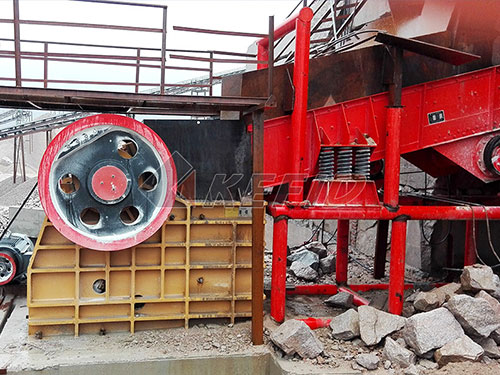

Targeted Solutions for Quarry Ballast Production: Addressing Core Operational Challenges
Producing consistent, specificationgrade railway ballast is a critical yet demanding process. Inefficient crushing directly impacts your bottom line through excessive wear costs, unscheduled downtime, and rejected material. Are you facing these persistent challenges?
High Abrasion Costs: Are premature liner and hammer wear on your primary crusher consuming 2030% of your annual maintenance budget?
Cubicity & Gradation Failures: Is a significant portion of your output failing ASTM D448 or AREMA 24, 25, or 4A specifications, forcing recrushing or relegating material to lowervalue applications?
Unscheduled Downtime: Does the failure of a single critical component halt your entire production line for 12+ hours, missing crucial delivery windows?
Inefficient Fines Generation: Are you overcrushing material to achieve yield, creating excess fines (below 3/8") that represent lost revenue and require separate handling?
Energy Intensity: Does your secondary/tertiary crushing stage account for over 40% of your plant's energy consumption per ton?
This content outlines the engineered approach behind modern quarry ballast crushing equipment, designed to systematically address these pain points.
Product Overview: HighYield Ballast Crushing Systems
Modern quarry ballast crushing equipment refers to configured stationary or semimobile crushing circuits optimized for producing highvolume aggregate for railway construction and maintenance. The operational workflow is engineered for specification control:
1. Primary Reduction: Dump feed is reduced to <200mm by a robust jaw or gyratory crusher.
2. Secondary Shaping & Sizing: Material is conveyed to a cone crusher configured for intermediate ballast fractions.
3. Tertiary Cubicity Refinement: A vertical shaft impactor (VSI) or highpressure grinding roll (HPGR) is often employed for final grain shaping and fines management.
4. Precise Screening: Multideck screens with defined apertures separate output into specification fractions (e.g., 63mm50mm, 50mm25mm) and scalp excess fines.
5. Recirculation: Offspec oversize is automatically returned to the appropriate crusher stage.
Application Scope: Ideal for hard rock (granite, basalt) and dense limestone quarries supplying national rail networks and heavyhaul freight lines. Limitations include feed rock with uniaxial compressive strength (UCS) consistently exceeding 300 MPa without specific circuit adaptations.
Core Features: Engineered for Ballast Profitability
Advanced Chamber Geometry | Technical Basis: Optimized kinematics & cavity profile | Operational Benefit: Produces a higher percentage of interlocking, fractured faces in first pass | ROI Impact: Reduces recirculation load by up to 15%, lowering energy cost per ton.
Liner Material Science | Technical Basis: Austenitic manganese steel with microalloying elements | Operational Benefit: Increases wear life by 3050% in highly abrasive environments | ROI Impact: Cuts liner inventory costs and changeout downtime, improving plant availability.
Automated Setting Regulation (ASR) | Technical Basis: Hydraulic adjustment with realtime feedback loops | Operational Benefit: Maintains target closedside setting (CSS) compensating for wear, ensuring consistent gradation | ROI Impact: Reduces product variability; field data shows a 90% reduction in outofspec batches.
Integrated Fines Management System | Technical Basis: Cascading flow with dedicated screening and airclassification | Operational Benefit: Actively removes deleterious fines postcrushing without washing | ROI Impact: Increases saleable yield by 38%, turning waste into revenue.
Centralized Greasing & Condition Monitoring | Technical Basis: Automated lubrication intervals based on bearing load cycles & temperature sensors | Operational Benefit: Prevents bearing failures, the leading cause of catastrophic crusher damage | ROI Impact: Predictive maintenance can extend major overhaul intervals by thousands of operating hours.
Competitive Advantages: Quantifiable Performance Metrics
| Performance Metric | Industry Standard Baseline | Advanced Quarry Ballast Crushing Solution | Documented Advantage |
| : | : | : | : |
| Product Cubicity Ratio (PCR) | Avg. 7075% within spec band | Consistently >85% within spec band | +1520% improvement |
| Wear Cost per Ton Processed | $0.85 $1.20 USD/tonne | $0.55 $0.75 USD/tonne | ~35% reduction |
| System Availability (Scheduled Runtime) | 8588% | 9295%+ | +7% absolute increase |
| Energy Consumption (Secondary/Tertiary) | 1.8 2.2 kWh/tonne | 1.4 1.7 kWh/tonne | Up to 25% improvement |
| Yield of Premium Ballast Fraction (%)| ~6570% of feed mass| ~7580% of feed mass| +1015% more saleable product |
Technical Specifications
System Capacity Range: Configurable from 200 to over 1,200 tonnes per hour (TPH).
Power Requirements: Primary circuit typically from 150 kW to over 400 kW; total installed plant power from 600 kW to >2 MW.
Material Specifications: Engineered for rock with UCS from 150 MPa to 350 MPa; maximum feed size up to ~90% of crusher inlet dimensions.
Key Physical Dimensions: Primary crusher footprint from ~6m x ~5m; complete modular plant footprint from ~40m x ~25m.
Environmental Operating Range: Designed for ambient temperatures from 20°C to +45°C with optional kits; dust emission controls standard (<10 mg/Nm³ achievable).
Application Scenarios
HeavyHaul Freight Line Supplier Challenge:
A granite quarry supplying ballast for a major coal corridor faced excessive flakiness in its 4A fraction (5025mm), leading to rapid track settlement under heavy axle loads.
Solution:
Implementation of a tertiarystage VSI crusher in rockonrock configuration within their existing quarry ballast crushing equipment circuit.
Results:
Achieved a sustained cubicity ratio >90%. Track bed life extended by an estimated 30%, securing a longterm supply contract based on performance guarantees.
Urban Metro System Expansion Challenge:
A basalt quarry near a metropolitan area needed to drastically reduce noise and dust emissions while increasing output by 40% for a new metro line project within strict environmental limits.
Solution:
Deployment of a fullyenclosed, semimobile crushing and screening plant with advanced sound dampening and electrostatic dust suppression integrated into the quarry ballast crushing equipment flow.
Results:
Met all municipal noise (<70 dB at site boundary) and dust regulations without productivity loss; achieved 450 TPH output within the new urban compliance framework.
Commercial Considerations
Pricing tiers are determined by system configuration and capacity:
Tier I (Primary Focus): Upgrades to existing primary jaw/gyratory with advanced liners and automation packages ($250k $750k USD).
Tier II (Complete Secondary/Tertiary Module): New cone crusher & VSI circuit with screening tower ($1.5M $3M USD).
Tier III (Turnkey System): Fully integrated stationary or mobilefixed plant from primary feed to final product stockpiling ($4M $10M+ USD).
Optional features include remote telematics packages, automated wear part monitoring systems, and hybrid drive systems for peakload shaving.
Service packages range from basic planned maintenance agreements to fullperformance contracts where availability guarantees are provided.
Financing options commonly include capital lease agreements, operating leases with upgrade options, and projectspecific financing tied to the supply contract duration.
Frequently Asked Questions
Q1: Can this equipment be integrated into our existing fixed plant layout?
A1: Yes. Modern quarry ballast crushing solutions are designed as modular units. A detailed site audit determines integration points for conveyors, chutes, and electrical connections with minimal disruption.
Q2: What is the typical implementation timeline from order commissioning?
A2 For a Tier II modular system delivery erection commissioning typically requires 6 months Tier III greenfield plants require 12 months Detailed project planning phases provide precise schedules
Q3 How does improved cubicity translate directly into cost savings for our end client the railway operator
A3 Superior interlock reduces track bed settlement decreasing the frequency of tamping ditching and full ballast renewal cycles Industry studies correlate high PCR ballast with 20 lower lifecycle maintenance costs
Q4 What are the payment terms available
A4 Standard terms involve progress payments tied to milestones like equipment shipment arrival at port site erection completion Successful performance test runs Final payment percentages vary
Q5 What operator training is provided
A5 Comprehensive training covers safe operation routine maintenance diagnostics troubleshooting Training occurs both at our facility during FAT Factory Acceptance Test at your site during commissioning
Q6 Are performance guarantees offered on product gradation yield
A6 Yes performance guarantees based on agreed feed material characteristics are standard These guarantee key metrics like throughput tonshour percentage yield within specified gradation bands power consumption per ton
Q7 What is the expected service life before major overhaul
A7 With proper maintenance core crusher structures have service lives exceeding years Major component life bearings etc varies by application but targeted intervals are 000s hours based on monitored operating conditions