
Quarry Ballast Crushing Equipment Dealer Quality Control


Targeting Quarry Managers, Plant Superintendents, and Engineering Contractors
1. PainPoint Driven Opening: The True Cost of Inconsistent Ballast
Producing railway ballast to meet stringent ASTM D448, AREMA 24, 25, or EN 13450 specifications is a persistent operational challenge. Inconsistent product quality leads directly to rejected loads, contract penalties, and costly reprocessing. Common pain points include:
Excessive Fines Generation: Overcrushing in secondary or tertiary stages creates excess fines (200 mesh material), degrading drainage properties and leading to load rejection by rail authorities.
Cubicity Failures: Flaky or elongated particles from improper crushing reduce interlock strength, compromising track bed stability and longevity.
Unscheduled Downtime: Frequent liner changes on crushers not designed for abrasive igneous rock (granite, basalt) or hard limestone halt your primary production line.
High Operational Costs: Energyinefficient crushing circuits and high wear part consumption per ton directly erode profit margins on a highvolume, competitive product.
Are you managing these costs? Is your current crushing equipment configured to maximize yield of inspec ballast while controlling fines and wear?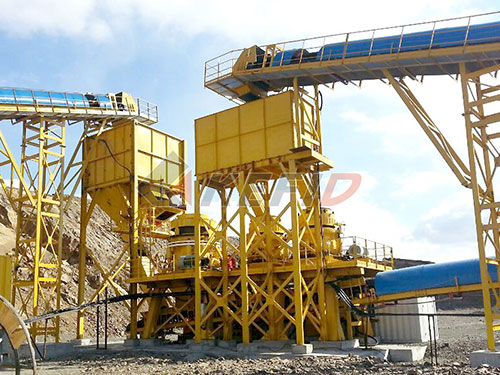
2. Product Overview: HighYield Ballast Crushing Plant

Our engineered solution is a stationary or modular crushing and screening plant specifically configured for highvolume quarry ballast production. The system is designed to transform blasted quarry run (typically 0750mm) into precisely graded railway ballast.
Operational Workflow:
1. Primary Reduction: Dump feed is reduced by a robust jaw crusher or primary gyratory to 250mm.
2. Secondary Shaping & Sizing: The heart of the system—a highinertia cone crusher—receives the primary crushed material. Its specific chamber design and crushing action are calibrated for particle shaping.
3. Critical Screening & Recirculation: A multideck horizontal screen precisely separates the product into oversize, inspec ballast (e.g., 2565mm), and undersize/fines. Oversize is recirculated to the cone crusher; undersize is diverted for aggregate byproducts.
4. (Optional) Tertiary Crushing for Chips: A tertiary vertical shaft impactor (VSI) can be integrated to produce rail head chip (ballast shoulder) from screened fractions with superior cubicity.
Application Scope & Limitations:
Scope: Ideal for dedicated ballast production from hard, abrasive rock types. Configurations are available for outputs from 150 to 600+ tons per hour.
Limitations: Not suitable for soft or highly friable sedimentary rock without significant configuration review. Feed size must be controlled within crusher intake limits.
3. Core Features: Engineered for Ballast Specification Compliance
Automated Control System | Technical Basis: PLC with CSS & load monitoring | Operational Benefit: Maintains consistent closedside setting (CSS) on the cone crusher in realtime, compensating for liner wear to ensure continuous product gradation | ROI Impact: Reduces gradationrelated rejections by an estimated 6080%, maximizing saleable yield.
MultiAction Crushing Chamber | Technical Basis: Optimized stroke, throw, and chamber geometry | Operational Benefit: Promotes interparticle crushing in the secondary stage, producing a higher ratio of cubic particles while minimizing direct metaltorock contact and fines generation | ROI Impact: Improves cubicity index by up to 35%, enhancing product value and reducing wear part costs per ton.
HeavyDuty Abrasion Package | Technical Basis: Highchrome martensitic steel liners, armored feed hoppers, and abrasionresistant steel on chutes | Operational Benefit: Extends operational campaigns between planned maintenance stops in highly abrasive environments | ROI Impact: Field data shows a 2040% increase in liner life compared to standard manganese setups, lowering cost per ton.
Integrated Fines Management Screen Deck | Technical Basis: Dedicated wash screen or highfrequency dry screen deck with precise mesh sizing | Operational Benefit: Actively removes deleterious fines before final product stacking, ensuring onspec drainage characteristics from the first load | ROI Impact: Virtually eliminates reprocessing costs due to excess fines contamination.
Centralized Lube & Hydraulic System | Technical Basis: Singlepoint lube distribution with temperature and flow monitoring | Operational Benefit: Protects critical crusher bearings and hydraulics from dust ingress and thermal overload, enhancing reliability | ROI Impact: Reduces risk of catastrophic bearing failure, a leading cause of extended unplanned downtime.
4. Competitive Advantages
| Performance Metric | Industry Standard Solution | Our Ballast Crushing Solution | Advantage (% Improvement) |
| : | : | : | : |
| InSpec Yield (% of total feed) | 5565% (varies with rock type) | 7080% (system dependent) | +1525% Saleable Product |
| Wear Cost per Ton (Abrasive Rock) | $0.85 $1.20 USD/tonne output| $0.60 $0.90 USD/tonne output| ~25% Reduction |
| Average Uptime Availability (Annual) | 8892% (planned & unplanned stops)| 9396% (focused on planned maintenance)| +5% Production Time |
| Power Consumption per Ton kWh/tonne)| Varies widely; often suboptimal| Optimized circuit flow reduces recirculation load| Up to 12% Reduction |
5. Technical Specifications
Capacity Range: Configurable from 150 TPH to over 600 TPH final ballast product.
Power Requirements: Primary plant motors typically require a total connected power of 350kW – 800kW depending on configuration; electrical package can be matched to local grid requirements.
Material Specifications: Engineered for compressive strength >150 MPa rock types (e.g., granite, trap rock). Critical wear components manufactured from M2 or M3 grade manganese steel or equivalent/superior abrasionresistant alloys.
Physical Dimensions (Modular Example): Secondary/Tertiary module approx. L18m x W5m x H6m; designed for transportability and rapid site commissioning.
Environmental Operating Range: Designed for ambient temperatures from 20°C to +45°C with optional heating/cooling packages for lube systems; dust suppression system compliant with standard regulations.
6. Application Scenarios
Hard Rock Quarry Supplying National Rail Project
Challenge: A granite quarry winning a major rail contract struggled with a cubicity ratio below 80% using standard cone crushers, risking noncompliance with project EN standards.
Solution: Implementation of a secondary crushing stage with a multiaction cone crusher specifically tuned for particle shaping over maximum reduction.
Results: Cubicity ratio improved to consistently over 92%. Plant achieved a certified yield of inspec ballast at 78% of total feed volume versus the previous benchmark of 60%.
Aggregate Producer Diversifying into Rail Ballast
Challenge: An established limestone aggregate producer needed to modify their existing circuit (<200 TPH) to produce AREMA 4 ballast without investing in an entirely new greenfield plant.
Solution: A tailored retrofit package replacing an existing tertiary crusher with a VSI module dedicated to producing cubic shoulder chippings and reconfiguring screen decks.
Results: The plant now produces two certified products—primary ballast and shoulder chips—with under 1% oversize rejection at the rail loading depot.
7. Commercial Considerations
Our solutions are offered under flexible commercial models:
Equipment Pricing Tiers:
Tier I – Core Machine Upgrade (Crusher/Screen Only): For operations integrating into existing infrastructure.
Tier II – Modular Production Plant (Skidmounted Secondary/Tertiary/Screening): For semipermanent satellite sites or expansions.
Tier III – Turnkey Stationary Crushing Plant Design & Supply.
Optional Features & Packages:
Advanced Dust Suppression System
OnBoard Weighing & Telemetry Package
Automated Wear Part Monitoring Sensors
Extended Warranty on Major Drives
Service Packages Available PostSale:
| Package Name Coverage Key Inclusions |
||||
Performance Plan Scheduled Maintenance Annual inspection parts kits remote monitoring access
Productivity Plan Scheduled + Unscheduled Priority parts dispatch field service engineer support uptime guarantee
Protection Plan Comprehensive Full parts coverage excluding consumables planned rebuilds
(Subject to terms & conditions)
Financing options including equipment leasing capital loans through our partners are available subject credit approval
Frequently Asked Questions
Q1 Is this equipment compatible with our existing primary jaw crusher screening setup?
Yes Our secondary tertiary modules are designed as bolton solutions Most implementations involve connecting via existing conveyor systems Control integration can be managed through standalone PLCs
Q2 What is the expected impact on our overall plant energy consumption?
Properly configured circuits often reduce specific energy consumption kWh per tonne by optimizing recirculation loads While adding equipment increases total connected power efficient design typically improves overall energy efficiency per ton of saleable product
Q3 How long does commissioning take what operator training is provided?
For modular plants typical commissioning time is days not weeks We provide comprehensive onsite training for your operations maintenance teams covering daily checks operation troubleshooting safety procedures
Q4 What are typical lead times payment terms?
Lead times vary based on configuration complexity Current standard lead times range months Payment terms generally involve progress payments tied manufacturing milestones delivery final commissioning
Q5 Can you guarantee final product gradation compliance?
While final gradation depends on feed material characteristics we provide performance guarantees based certified test reports using your site samples These guarantees cover machine capacity power consumption wear rates under defined operating conditions