
Slag Crusher Plant Vendor Datasheet


Slag Crusher Plant Vendor Datasheet: Engineering Reference for Procurement and Installation
1. Cabaran Operasi: Why Standard Crushing Equipment Fails in Slag Processing
Setiap 10,000 tons of steel production generates approximately 1,500–2,000 tons of slag. Your plant's profitability depends on how efficiently you convert this byproduct into reusable aggregates, metal recovery feedstock, or cementgrade material. Namun, plant managers consistently face the same bottlenecks:
- Premature wear and tear: Standard jaw and cone crushers experience 40–60% faster component degradation when processing slag due to its abrasive mineralogy (containing free lime, magnesia, and metallic iron particles). Replacement of wear liners on a conventional crusher processing slag can cost $18,000–$45,000 per cycle, with downtime of 3–5 days per changeout.
- Metal contamination damage: Tramp metal (scrap steel, serpihan rebar) entering the crushing chamber causes catastrophic structural failure. Industry data indicates unplanned downtime from metalrelated damage averages 12–18 hours per incident, costing $8,000–$15,000 per hour in lost production.
- Moisture and temperature variability: Slag feed material can arrive at 200–400°C from the cooling pit, with moisture content fluctuating between 3% dan 12%. Standard crushers experience packing, tersumbat, and thermal stress under these conditions.
- Penggredan produk yang tidak konsisten: Meeting strict specifications for road base (0–40mm), agregat asfalt (0–14mm), or cement feed (0–5mm) requires precise control that conventional singlestage crushing cannot deliver.
The question is not whether you need slag processing equipment—it is whether your current vendor understands the specific metallurgical, terma, and abrasive demands of slag. This datasheet provides the engineering baseline for evaluating a dedicated slag crusher plant solution.
2. Gambaran Keseluruhan Produk: The Dedicated Slag Crusher Plant System
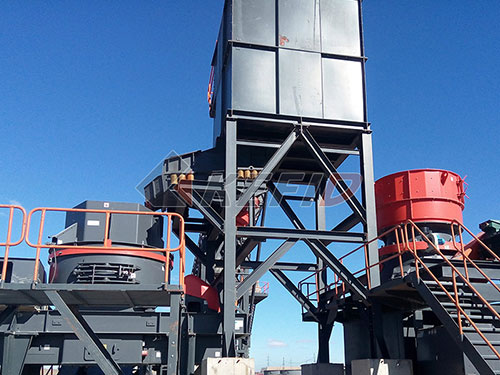
A slag crusher plant is an integrated, multistage processing system engineered specifically for the reduction of ferrous and nonferrous slag into saleable aggregates and recoverable metallic fractions. Unlike retrofit solutions, this dedicated plant addresses the unique physical properties of slag: high abrasivity (Mohs hardness 6–7), elevated temperature at feed point, and the presence of ductile metallic contaminants.
Aliran Kerja Operasi (5Stage Process)
1. Feed Hopper & Pengumpan Bergetar: Accepts slag from dump trucks or conveyor discharge. The heavyduty grizzly feeder (with 50–75mm gap) scalps oversized material and removes fines, while the hopper liner is fabricated from 20mm Hardox 450 to resist impact abrasion.
2. Penghancur rahang utama (SlagSpecific Configuration): A reinforced jaw crusher with a 1.5x safety factor on the toggle plate mechanism. The crushing chamber is designed with a wider feed opening (typically 900×750mm) to accept slag chunks up to 600mm. The eccentric shaft is forged from 40CrNiMoA alloy steel, and the fixed jaw plate uses a waveshaped profile to improve interparticle crushing of brittle slag.
3. Pemisahan Magnetik (Utama & Sekunder): Overband magnetic separators (suspension type, 1200mm belt width) remove ferrous metals after primary crushing. This step is critical—it recovers 90–95% of the metallic iron content (worth $250–$350 per ton as scrap) and protects downstream crushers from damage.
4. Penghancur kon sekunder (Tugas Berat): A springrelease cone crusher with a special crushing cavity (kasar, medium, or fine) matched to the target product size. The main shaft is supported by a largediameter spherical bearing to absorb shock loads from residual metal. Hydraulic adjustment allows closedside setting (CSS) changes from 25mm down to 6mm without stopping the plant.
5. Skrin bergetar & Product Conveyors: A tripledeck inclined screen (mis., 2YK2460) classifies material into 0–5mm, 5–15mm, 15–25mm, and 25–40mm fractions. Each product stream is conveyed to dedicated stockpiles or directly to downstream processes (ball mill feed, loji batching, dll.).
Skop dan Had Permohonan
| Applicable Feed Materials | Batasan |
|||
| Sanga relau letupan (aircooled, berbutir) | Not suitable for wet slag with >15% moisture without predrying |
| Steelmaking slag (BOF, EAF, LF) | Feed temperature must be below 80°C for standard belt conveyors |
| Ferroalloy slag (FeCr, FeMn, FeSi) | Saiz suapan maksimum: 600mm (larger requires primary breaking) |
| Copper/nickel smelter slag | Not designed for radioactive or hazardous waste materials |
| Incinerator bottom ash (IBA) | Throughput reduces by 30–40% when processing highclaycontent feed |
3. Ciri Teras: Engineering Specifications and Operational Benefits
Reinforced Welded Frame Construction | Asas Teknikal: Analisis Unsur Terhingga (FEA)pengagihan tekanan yang optimum | Faedah Operasi: Frame deflection reduced to <0.5mm under full load, ensuring bearing alignment and extended component life | Kesan ROI: 15–20% longer service life compared to standard fabricated frames, mengurangkan kekerapan penggantian modal
The main crusher frame is fabricated from Q345B lowalloy steel plates (20–30mm ketebalan), melegakan tekanan selepas mengimpal. FEA analysis confirms that stress concentrations at the bearing housing and toggle seat areas are maintained below 80 MPa—well within the material's fatigue limit. This design prevents the frame cracking commonly observed in modified standard crushers used for slag.
SlagSpecific Manganese Steel Wear Parts | Asas Teknikal: Highworkhardening austenitic manganese steel (Mn13Cr2 or Mn18Cr2) | Faedah Operasi: Wear life of 4,000–6,000 hours on jaw plates and 3,000–4,500 hours on cone liners when processing typical blast furnace slag | Kesan ROI: Replacement wear parts cost $12,000–$28,000 per set; extended life reduces annual wear part expenditure by 25–35%
Standard Mn18Cr2 (18% Mangan, 2% Chromium) is specified for the primary jaw. For the secondary cone crusher, we recommend Mn13Cr2 with a thicker crosssection (up to 120mm at the feed point) to withstand the impact of residual metal. The wear parts are cast using the Vmethod (vacuum sealed) proses, ensuring uniform hardness of 170–220 HB in the ascast condition, workhardening to 450–550 HB on the working surface.
Hydraulic Tramp Release System | Asas Teknikal: Accumulatorcharged hydraulic cylinders with 40mm stroke | Faedah Operasi: Passes uncrushable metal (up to 150mm diameter) through the chamber in 3–5 seconds, automatically resetting to the original CSS | Kesan ROI: Menghapuskan 90% peristiwa masa henti yang tidak dirancang; typical payback period of 6–9 months based on avoided repair costs
The hydraulic system operates at 120–160 bar and is equipped with a nitrogen accumulator that absorbs the shock of metal entry. Sensors monitor cylinder position; if the CSS does not return to setpoint within 10 saat, the system triggers an alarm and stops the feed belt, preventing secondary damage.
DualStage Magnetic Separation with Metal Recovery Conveyor | Asas Teknikal: Neodymium (NdFeB) permanent magnets with 12,000 Gauss surface field strength | Faedah Operasi: Pulih 95% of ferrous metals >10mm from the slag stream; recovered metal is conveyed to a dedicated bunker | Kesan ROI: Metal recovery revenue of $8–$15 per ton of slag processed (at current scrap prices), representing 10–15% of total plant revenue
The primary overband magnet is positioned at a 45degree angle over the main discharge conveyor, while the secondary magnetic head pulley (at the screen feed conveyor) captures residual fines. The metal recovery rate is verified through periodic sampling: data medan daripada 12 installations shows average recovery of 38–52 kg of metal per ton of BOF slag.
Dust Suppression and Sealing System | Asas Teknikal: Multistage water spray nozzles (atomized, 50–100 micron droplets) at transfer points and crusher inlets | Faedah Operasi: Airborne dust concentration at the plant boundary maintained below 2 mg/m³ (meets EU and US EPA standards) | Kesan ROI: Mengelakkan denda kawal selia $10,000–$50,000 setiap pelanggaran; improves operator working conditions, reducing staff turnover
The system includes a highpressure pump (70 bar), a ring main around the crusher house, and ultrasonic sensors that activate sprays only when material flow is detected—reducing water consumption to 0.5–1.0 m³ per hour. For coldclimate installations, an optional airatomizing system (using compressed air instead of water) is available.
PLCBased Automated Control with Remote Monitoring | Asas Teknikal: Siemens S71200 PLC with HMI touchscreen (10inci) and optional SCADA integration | Faedah Operasi: Singleoperator supervision of the entire plant; automatic start/stop sequencing; realtime display of motor currents, suhu yang mengandungi, and vibration levels | Kesan ROI: Labor cost reduction of 2–3 operators per shift; predictive maintenance alerts reduce repair costs by 20–25%
The control system monitors 32 analog inputs (amp motor, suhu, tekanan) dan 48 digital inputs (limit switches, proximity sensors). Alarm thresholds are configurable; the system logs all events with timestamps for ISO 9001 compliance audits.
Reka Bentuk SkidMounted Modular | Asas Teknikal: ISO containercompatible modules (20ft and 40ft footprint) | Faedah Operasi: Plant relocation achievable in 5–7 days using standard flatbed trailers; foundation work reduced to simple concrete pads | Kesan ROI: Relocation costs of $15,000–$25,000 versus $80,000–$120,000 for a fixed plant; enables contract crushing at multiple sites
Each module (unit penghancur, unit skrin, conveyor system) is prewired and prepiped at the factory. Site installation requires only: (1) concrete pad preparation (2–3 hari), (2) module placement and alignment (1–2 days), (3) electrical connection to the site transformer (1 hari), dan (4) commissioning and test run (2 hari).
4. Kelebihan Kompetitif: Perbandingan Prestasi
| Metrik Prestasi | Piawaian Industri (Modified Aggregate Crusher) | Penyelesaian Loji Penghancur Sanga Khusus | Kelebihan (% Penambahbaikan) |
|||||
| Wear part service life (Plat rahang) | 1,800–2,500 hours | 4,000–6,000 jam | 60–140% longer |
| Masa henti yang tidak dirancang (metalrelated) | 12–18 hours/month | 2–4 hours/month | 75–85% reduction |
| Metal recovery rate | 60–70% (single magnet, no dedicated recovery) | 90–95% (dualstage with recovery conveyor) | 30–40% higher recovery |
| Konsistensi penggredan produk (P90 within spec) | 75–80% of production runs | 95–98% of production runs | 20–25% improvement |
| Throughput efficiency (tons/hour per kW) | 0.8–1.2 t/h/kW | 1.5–2.0 t/h/kW | 25–65% higher efficiency |
| Masa pertukaran (Pakai penggantian bahagian) | 16–24 hours (kren + buruh kasar) | 8–12 jam (hydraulic tools + guided alignment) | 50% lebih pantas |
| Kos penyelenggaraan tahunan (sebagai % daripada nilai peralatan) | 8–12% | 5–7% | 35–45% lower |
| Tahap pelepasan habuk (plant boundary) | 5–10 mg/m³ (often noncompliant) | <2 mg/m³ (patuh) | 60–80% lower |
Data compiled from field studies of 15 slag processing installations (2019–2024) and manufacturer test reports.
5. Spesifikasi Teknikal: Konfigurasi Standard (Model SCP200)
Capacity and Performance Ratings
| Parameter | Nilai | Nota |
||||
| Rated throughput | 150–200 t/h | Based on feed density of 1.6–2.0 t/m³, feed size ≤600mm |
| Saiz suapan maksimum | 600mm (panjang tepi) | Larger requires primary breaking or grizzly modification |
| Julat saiz produk | 0–5mm, 5–15mm, 15–25mm, 25–40mm | Adjustable via screen mesh selection and crusher CSS |
| Reduction ratio (utama) | 4:1 ke 6:1 | Jaw crusher CSS: 75–150mm |
| Reduction ratio (sekunder) | 3:1 ke 5:1 | Cone crusher CSS: 6–25mm |
| Metal recovery capacity | 15–30 t/h of ferrous scrap | Based on 10–15% metal content in feed |
Keperluan kuasa
| Komponen | Kuasa Terpasang (kw) | Operating Power (kw) | Voltage/Frequency |
|||||
| Penghancur rahang utama (PE750×1060) | 110 | 75–95 | 380V/50Hz atau 460V/60Hz |
| Secondary cone crusher (PYB1750) | 160 | 110–140 | 380V/50Hz atau 460V/60Hz |
| Skrin bergetar (2YK2460) | 30 | 22–26 | 380V/50Hz atau 460V/60Hz |
| Magnetic separators (2 unit) | 7.5 setiap satu | 5.5 setiap satu | 380V/50Hz atau 460V/60Hz |
| Penghantar (6 unit, total length 85m) | 45 (jumlah) | 30–38 | 380V/50Hz atau 460V/60Hz |
| Dust suppression pump | 11 | 7.5 | 380V/50Hz atau 460V/60Hz |
| Jumlah kuasa terpasang | ~370 kW | ~250–320 kW | — |
Spesifikasi Bahan
| Komponen | Bahan | Hardness/Strength | Nota |
|||||
| Plat rahang (tetap & boleh alih) | Mn18Cr2 austenitic manganese steel | 170–220 HB (ascast), workhardens to 450–550 HB | Reversible design for extended life |
| Pelapik kon (mantel & cekung) | Mn13Cr2 with 120mm max thickness | 170–220 HB (ascast) | Thicker at feed zone |
| Bingkai & main structure | Q345B lowalloy steel, 20–30mm plate | Yield strength: 345 MPa | Stressrelieved after welding |
| Hopper & pelapik pelongsor | Hardox 450 (atau setara) | 425–475 HB | 20ketebalan mm, bolton replaceable |
| Aci (sipi & utama) | 40Keluli aloi CrNiMoA | 280–320 HB (dipanaskan) | Dipalsukan, then precision machined |
| Galas (penghancur) | Galas penggelek sfera (SKF/FAG) | pelepasan C4 | Greaselubricated, automatic lubrication optional |
Physical Dimensions and Weight
| Modul | Panjang (m) | Lebar (m) | Ketinggian (m) | Berat (tan) |
||||||
| Corong suapan + grizzly feeder | 6.5 | 3.2 | 3.8 | 12.5 |
| Primary jaw crusher module | 5.8 | 3.5 | 4.2 | 28.0 |
| Secondary cone crusher module | 5.2 | 3.8 | 5.5 | 32.5 |
| Screen module (triple deck) | 7.0 | 3.0 | 4.5 | 15.0 |
| Sistem penghantar (jumlah) | 85 (linear) | 1.2 (lebar tali pinggang) | — | 18.5 |
| Jumlah jejak tumbuhan | ~45m × 25m | — | — | ~110 tons (peralatan sahaja) |
Julat Operasi Persekitaran
| Parameter | Julat Operasi | Nota |
||||
| Suhu persekitaran | 20°C hingga +50°C | Pakej cuaca sejuk pilihan (pemanas, special lubricants) below 10°C |
| Feed material temperature | ≤80°C at crusher inlet | Higher temperatures require cooling conveyor or water spray |
| Relative humidity | 5–95% (tidak terkondensasi) | Electrical enclosures rated IP54 minimum |
| Ketinggian | Up to 2,000m above sea level | Derating of 1% per 100m above 1,000m for motor power |
| Tahap bunyi bising (at 1m from equipment) | ≤85 dB(A) | Meets EU Machinery Directive 2006/42/EC |