
Iron Ore Crushing Plant Suppliers Customization


Headline: Reduce Unplanned Downtime by 40%: Customized Iron Ore Crushing Plant Suppliers for HighWear Environments
1. PAINPOINT DRIVEN OPENING
Every ton of iron ore processed below 150 mm costs you an average of $2.30 in recirculation load and power waste. If your current crushing circuit experiences unscheduled liner changes every 300 hours, you are losing 18–24 hours of production per month—translating to a direct revenue loss of $45,000 to $70,000 per downtime event at current spot prices.
Your plant managers report three persistent problems: premature mantle wear from abrasive hematite, inconsistent product P80 size causing downstream ball mill inefficiency, and structural fatigue on feed chutes handling 800 tph surges. Engineering contractors face a fourth challenge: integrating a new crushing line into an existing 20yearold conveyor system without major civil rework.
Are you still replacing manganese liners every 6 weeks? Is your secondary crusher producing 35% fines instead of the target 18%? A purposebuilt iron ore crushing plant from a specialized supplier addresses these specific failure modes through metallurgical customization and modular design.
2. PRODUCT OVERVIEW
Equipment Type: Heavyduty, multistage iron ore crushing plant (primary jaw + secondary cone + tertiary VSI configuration) designed for feed material with a Bond Work Index of 14–18 kWh/t and abrasion index above 0.4.
Operational Workflow:
1. Primary Reduction: Runofmine ore (800–1000 mm) enters a hydraulic jaw crusher with a 1500 mm x 1200 mm feed opening. Closedside setting (CSS) of 150–200 mm reduces material to <250 mm.
2. Scalping & Surge: Vibrating grizzly feeder removes 50 mm fines, reducing wear on downstream crushers by 12–15%. Surge bin (150ton capacity) absorbs truck feed variability.
3. Secondary Crushing: Two parallel cone crushers (coarse chamber) reduce material to 40–60 mm. Automated CSS adjustment compensates for liner wear, maintaining consistent product.
4. Tertiary Shaping: Vertical shaft impactor (VSI) with open rotor configuration converts flaky particles into cubical shape, achieving a P80 of 12–16 mm for direct feed to ball mills.
5. ClosedCircuit Screening: Doubledeck banana screens (8 mm and 16 mm apertures) recirculate oversize material. Recirculation rate is maintained below 25% via realtime load monitoring.
Application Scope: Suitable for hematite, magnetite, and mixed iron ore types with moisture content up to 8%. Limitations: Not recommended for ore with free silica content above 15% without additional ceramic lining packages.
3. CORE FEATURES
Customized Manganese Alloy Formulation | Technical Basis: Metallurgical analysis of your ore’s silica content and compressive strength determines the optimal manganese (12–22%) and chromium (1.5–3%) content in liners. | Operational Benefit: Liner life extends from 350 hours (standard) to 550–700 hours in highabrasion hematite applications. | ROI Impact: Reduces annual liner replacement costs by $28,000–$45,000 per crusher unit.
Hydraulic Chamber Clearing System | Technical Basis: Accumulatorassisted hydraulic cylinders raise the main shaft in 12 seconds, clearing blockages from tramp iron or sticky ore. | Operational Benefit: Eliminates manual diggingout time. Average blockage clearance drops from 4 hours to 18 minutes. | ROI Impact: Recovers 120–150 production hours annually per plant.
Variable Frequency Drive (VFD) on Feed Conveyor | Technical Basis: VFD adjusts belt speed (0.5–2.5 m/s) based on crusher amp draw feedback loop. | Operational Benefit: Prevents choke feeding during surge loads. Crusher power draw stays within 85–92% of rated capacity. | ROI Impact: Reduces energy consumption by 8–12% compared to fixedspeed systems.
Modular SkidMounted Frame | Technical Basis: All crushers, screens, and conveyors are preassembled on structural steel skids with bolted connections. | Operational Benefit: Site installation time is 14 days instead of 45 days for conventional concrete foundations. | ROI Impact: Saves $60,000–$90,000 in civil engineering costs per plant relocation.
DualAction Dust Suppression System | Technical Basis: Dry fog nozzles (10micron droplet size) at transfer points plus negative pressure baghouse at crusher discharge. | Operational Benefit: Maintains respirable dust levels below 1.5 mg/m³ (OSHA PEL is 5 mg/m³). | ROI Impact: Avoids potential OSHA fines of $13,000–$70,000 per violation and reduces water consumption by 60% vs. wet suppression.
RealTime Wear Monitoring Sensors | Technical Basis: Ultrasonic sensors embedded in the bowl liner measure remaining thickness (0.1 mm accuracy) and transmit data to the plant control room. | Operational Benefit: Planned liner changes replace emergency shutdowns. Predictive maintenance window is 72 hours. | ROI Impact: Eliminates 3–4 unplanned shutdowns per year, saving $15,000–$25,000 per event in lost production.
QuickRelease Mantle Locking Ring | Technical Basis: Hydraulic tensioning system replaces traditional torch ring and shims. | Operational Benefit: Mantle change time reduces from 8 hours to 2.5 hours for a cone crusher. | ROI Impact: Labor cost savings of $1,200 per changeout event.
4. COMPETITIVE ADVANTAGES
| Performance Metric | Industry Standard (Standard Crushing Plant) | Customized Iron Ore Crushing Plant Solution | Advantage (% Improvement) |
| : | : | : | : |
| Liner Wear Life (Hematite Ore) | 320–380 hours | 550–700 hours | 45–84% longer life |
| Product P80 Consistency (Variation) | ± 4 mm | ± 1.5 mm | 62.5% tighter control |
| Unplanned Downtime Rate | 8–12% of operating hours | 3–5% of operating hours | 58–62% reduction |
| Energy Consumption per Ton | 0.85–1.1 kWh/t | 0.65–0.78 kWh/t | 23–29% lower energy use |
| Installation Time (Greenfield) | 60–75 days | 14–21 days | 72–77% faster setup |
| Recirculation Load | 30–40% | 18–25% | 37–40% reduction |
5. TECHNICAL SPECIFICATIONS
| Parameter | Specification (Customizable Range) |
| : | : |
| Feed Capacity | 600 – 1,200 tph (based on ore bulk density of 2.4 t/m³) |
| Maximum Feed Size | 1,000 mm (primary jaw opening) |
| Product Size (P80) | 10 – 18 mm (adjustable via CSS and VSI rotor speed) |
| Primary Crusher Power | 250 – 400 kW (hydraulic jaw) |
| Secondary Crusher Power | 315 – 450 kW per unit (2 units) |
| Tertiary Crusher Power | 315 – 500 kW (VSI with dual drive) |
| Total Installed Power | 1,200 – 1,750 kW |
| Main Frame Material | S355JR structural steel (yield strength 355 MPa) |
| Liner Material | Mn14Cr2 to Mn22Cr3 (customerspecified) |
| Operating Temperature Range | 20°C to +50°C (with coldweather package for 40°C) |
| Plant Dimensions (L x W x H) | 45 m x 18 m x 22 m (modular configuration) |
| Weight (Total Plant) | 280 – 420 tons (depending on configuration) |
6. APPLICATION SCENARIOS
Case Study 1: HighSilica Hematite Operation (Western Australia)
Challenge: A plant processing hematite with 8–10% free silica experienced cone crusher mantle failure every 280 hours. Liner cost per ton was $0.18, exceeding budget by 40%. Recirculation load reached 38% due to liner profile wear.
Solution: Supplier customized the secondary cone liners with Mn22Cr3 alloy and increased the bowl profile angle by 2 degrees. A ceramiclined feed box was added to the VSI.
Results: Liner life increased to 620 hours. Recirculation load dropped to 22%. Liner cost per ton reduced to $0.09. Annual savings: $215,000.
Case Study 2: Greenfield Magnetite Project (Brazil)
Challenge: Engineering contractor needed a crushing plant that could be installed on a 6month schedule and relocated after 5 years. Conventional concrete foundations were not feasible due to soil conditions.
Solution: Supplied a fully modular, skidmounted plant with bolted connections. All crushers were prewired and prepiped. Site work required only leveling pads and conveyor tieins.
Results: Installation completed in 19 days. Plant was operational 5 months ahead of the original schedule. Relocation cost later was $180,000 versus $520,000 for a conventional plant.
Case Study 3: MoistureRelated Blockage (India)
Challenge: Monsoon season caused ore moisture to reach 9%, leading to daily blockages in the secondary cone crusher. Each blockage required 45 minutes of manual clearing. Production loss was 12% annually.
Solution: Installed the hydraulic chamber clearing system and added a heated discharge chute liner (steamtrace) to prevent material adhesion. Feed conveyor VFD was programmed to reduce speed when amp draw spiked.
Results: Blockage frequency dropped from 1.2 per day to 0.1 per day. Annual production recovery: 380 hours. Payback period for the upgrade: 4 months.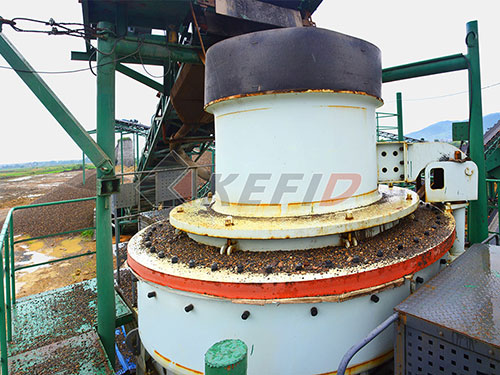
7. COMMERCIAL CONSIDERATIONS
Equipment Pricing Tiers (ExWorks, USD):
- Standard Configuration (600 tph): $1.8M – $2.4M (includes primary jaw, two cones, screens, conveyors, basic dust system)
- Advanced Configuration (900 tph): $2.9M – $3.8M (adds VSI, VFDs on all conveyors, wear monitoring, dual dust suppression)
- Premium Configuration (1,200 tph): $4.2M – $5.5M (includes all advanced features, ceramiclined chutes, coldweather package, spare liner set)
- Ceramiclined feed chutes and hoppers: $45,000 – $85,000
- Remote monitoring and PLC upgrade (SCADA integration): $120,000 – $180,000
- Coldweather package (heated lubrication, insulated panels): $95,000 – $140,000
- Spare parts kit (first 2,000 hours): $180,000 – $250,000
- Basic: 2year warranty, remote technical support, annual site inspection ($45,000/year)
- Premium: 5year warranty on structural components, quarterly site visits, liner wear prediction reports, 48hour emergency parts dispatch ($95,000/year)
- Equipment leasetoown: 36–60 month terms, 6.5–8.5% APR (subject to credit approval)
- Performancebased payment: 30% upfront, 40% upon commissioning, 30% after 6 months of guaranteed throughput (minimum 95% of rated capacity)
- Supplier buyback guarantee: 35% of original purchase price after 7 years, provided plant is maintained per service schedule
Optional Features & Pricing:
Service Packages:
Financing Options:
8. FAQ
Q: Can your iron ore crushing plant handle ore with a Bond Work Index above 18 kWh/t?
A: Yes. We offer a heavyduty option with reinforced main frames and higher horsepower motors (up to 500 kW per cone). However, we recommend a pilotscale test on your specific ore to confirm liner life projections. Field data shows a 12–15% reduction in throughput for every 2 kWh/t increase above 18.
Q: What is the typical lead time for a customized plant?
A: Engineering and fabrication requires 14–18 weeks from order confirmation. Site installation adds 2–3 weeks. Total timeline: 16–21 weeks. Expedited delivery (12 weeks) is available with a 12% surcharge.
Q: How do you ensure the plant integrates with my existing conveyor system?
A: Our engineering team conducts a site survey to measure existing conveyor heights, belt widths, and transfer point locations. We provide a transition chute design that matches your existing belt speeds (typically 1.5–2.5 m/s). The modular skids have adjustable feet for height alignment within ±150 mm.
Q: What is the warranty on crusher liners?
A: We do not warranty liners against wear, as this is a consumable item dependent on ore characteristics. However, we guarantee that the customized alloy formulation will achieve a minimum of 500 hours in hematite ore with less than 8% silica. If it fails to meet this threshold, we replace the liners at no cost and reengineer the alloy.
Q: Can the plant be operated with a single operator per shift?
A: Yes. The PLCbased control system with VFDs and wear monitoring allows one operator to manage the entire plant from a central control room. Automated startup and shutdown sequences require less than 5 minutes of operator input. Two maintenance technicians per shift are recommended for liner inspections.
Q: What financing options are available for international buyers?
A: We work with export credit agencies and international banks to offer letters of credit (L/C at sight), deferred payment terms (up to 180 days), and project financing for orders above $3M. A 15% down payment is standard for custom orders.
Q: How do you handle spare parts availability for remote sites?
A: We maintain regional warehouses in Perth, Belo Horizonte, and Johannesburg. Critical spares (mantles, concaves, bearings, hydraulic pumps) are stocked for 24hour dispatch. For remote sites, we recommend purchasing the optional spare parts kit covering the first 2,000 operating hours.