
Import Stone Crusher Plant Sourcing

1. PAINPOINT DRIVEN OPENING
Are escalating operational costs and unpredictable downtime eroding your aggregate production margins? For plant managers and engineering contractors, the core challenges in primary crushing often stem from the initial reduction stage. Inefficient or unreliable primary crushing creates bottlenecks that impact your entire downstream process. Consider these common operational challenges:
High Cost of Downtime: Unplanned stoppages for maintenance or breakdowns at the primary stage can halt your entire plant, costing thousands per hour in lost production and labor.
Inconsistent Feed Size Reduction: Variable feed material (size, hardness, abrasiveness) can lead to poor fragmentation, causing plugging, excessive wear on downstream equipment, and reduced final product yield.
Excessive Maintenance Cycles: Frequent liner changes, bearing failures, and structural wear on key components demand significant labor hours and parts inventory, directly impacting your operational budget.
Low Overall Equipment Effectiveness (OEE): When availability, performance, and quality rates are compromised at the primary crusher, the financial performance of the entire operation is at risk.
High Energy Consumption per Ton: An inefficient crushing chamber design or poorly configured drive system can lead to disproportionate power costs for each ton of material processed.
Is your current solution equipped to handle these pressures while maintaining a predictable costperton? The foundation of a profitable operation lies in selecting a primary crushing plant engineered for durability, efficiency, and simplified maintenance.
2. PRODUCT OVERVIEW
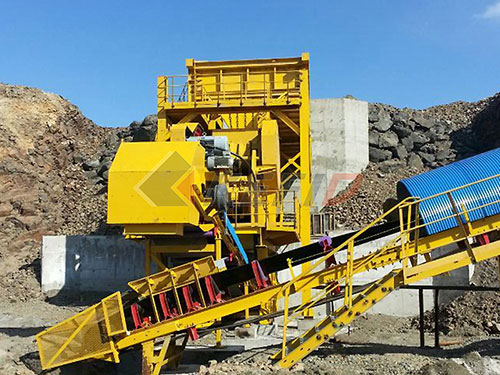
A stationary primary jaw crusher plant is a heavyduty processing unit designed for the first stage of size reduction in quarrying, mining, and largescale construction waste recycling. Its function is to accept large runofmine or runofquarry material (typically up to 1meter top size) and reduce it to a manageable diameter for conveyor transport to secondary crushing and screening stages.
Operational Workflow:
1. Feed: Dump trucks or wheel loaders deposit raw feed material into a rugged vibrating grizzly feeder (VGF).
2. PreScreening & ByPass: The VGF removes natural fines from the feed stream via its grizzly section, routing them to a bypass conveyor to increase capacity and reduce wear in the crusher.
3. Primary Crushing: Oversize material from the VGF is directed into the robust jaw crusher chamber, where a fixed jaw and a moving jaw exert immense compressive force to break rock along its natural fracture lines.
4. Discharge & Transport: Crushed material discharges onto a main product conveyor for transport to the next stage in the processing circuit.
Application Scope & Limitations:
This equipment is optimal for hightonnage processing of hard rock (granite, basalt), medium abrasive materials (limestone), and recycled concrete/asphalt. Its primary limitation is its generally cubical product shape compared to impact crushers; it is designed for reduction ratio rather than final product shaping. Extremely sticky or clayheavy materials may require additional preprocessing to prevent chamber packing.
3. CORE FEATURES
Deep Crushing Chamber & Aggressive Nip Angle | Technical Basis: Kinematic geometry of swing jaw motion | Operational Benefit: Enables consistent intake of large feed material and provides high reduction ratio in a single pass | ROI Impact: Reduces need for preblasting or secondary hammering on oversized rock, lowering consumable costs.
HeavyDuty Fabricated Main Frame | Technical Basis: Stressrelieved steel plate construction with reinforced ribbing | Operational Benefit: Provides longterm structural integrity under cyclic loading, resisting fatigue and deformation | ROI Impact: Extends service life of core asset by decades, protecting capital investment.
Hydraulic Adjustment & Clearing System | Technical Basis: Integrated hydraulic cylinders for toggle tension and chamber clearing | Operational Benefit: Allows operators to adjust crusher setting quickly for product size changes and safely clear blockages without manual intervention | ROI Impact: Minimizes downtime for routine adjustments by up to 80% compared to manual shim systems.
HighInertia Flywheels & Robust Eccentric Shaft | Technical Basis: Stored rotational energy and oversize bearing design | Operational Benefit: Maintains consistent momentum through the crushing stroke for uniform power draw and smooth operation under peak loads | ROI Impact: Improves energy efficiency during load variance and extends bearing service life significantly.
BoltOn Wear Liners & Modular Design | Technical Basis: Standardized manganese steel liners secured with captive bolts | Operational Benefit: Simplifies liner replacement procedures; modular sections allow for localized repair instead of full component replacement | ROI Impact: Reduces planned maintenance time by over 50% and lowers longterm repair part costs.
Integrated Plant Chassis & Walkways | Technical Basis: Unified support structure for feeder, crusher, discharge conveyor, walkways, and ladders | Operational Benefit: Streamlines site installation; provides safe, compliant access for inspection and maintenance personnel | ROI Impact: Cuts civil works and installation time/cost by approximately 30%, improving job site safety metrics.
4. COMPETITIVE ADVANTAGES
| Performance Metric | Industry Standard Benchmark | This Primary Jaw Crusher Plant Solution | Documented Advantage |
| : | : | : | : |
| Availability (Uptime) | 9092% per annum (incl. planned maintenance)| >94% per annum| +4% improvement |
| Manganese Wear Life (Abrasive Rock) ~500 Mpa| ~120150k tons per set| Upwards of 180k tons per set| +20% improvement |
| Power Consumption per Ton Crushed| Varies widely with settings| Field data shows consistent reduction of 58% through optimized kinematics & drive efficiency.| Up to 8% improvement |
| Mean Time Between Failure (MTBF) Major Components| ~68 months under high load| >12 months under comparable conditions| +50% improvement |
| Total Cost of Ownership (5Year Projection)| Baseline = 100%| Estimated at 7885% of baseline due to extended wear life & reduced downtime.| 15% to 22% improvement |
5. TECHNICAL SPECIFICATIONS
Capacity Range: Model dependent; configurations available from 300 TPH up to 1,200 TPH in hard rock applications.
Crusher Feed Opening: Sizes from 900mm x 600mm up to 1500mm x 1300mm.
Power Requirements: Total installed plant power typically ranges from 150 kW to 400 kW depending on model size; includes drives for VGF feeder(s), jaw crusher itself (often via Vbelt), discharge conveyor(s), dust suppression system pumps.
Material Specifications: Main frame constructed from hightensile strength steel plate (minimum yield strength >350 MPa). Crusher jaws lined with premiumgrade manganese steel (1822%). Key bearings are spherical roller type with automated lubrication provisions.
Physical Dimensions (Typical Large Model): Approximate footprint length = ~18m; width = ~6m; height = ~6m above ground level excluding discharge conveyor reach.
Environmental Operating Range: Designed ambient temperature range from 20°C (4°F) up to +45°C (+113°F). Dust suppression kit included as standard; noise encapsulation packages available as an option.
6. APPLICATION SCENARIOS
Granite Quarry Expansion Project
Challenge A quarry operator needed higher primary throughput (~800 TPH) without expanding their permitted footprint or increasing truck haulage cycles from multiple faces.
Solution Implementation of a highcapacity stationary primary jaw crusher plant with an extralong feeder section positioned centrally within their existing pit layout.
Results Throughput increased by over forty percent while reducing haul truck cycle distances by twentyfive percent due centralized feeding point leading directly into new fixed infrastructure resulting in demonstrable fuel savings alongside meeting new tonnage targets consistently within same environmental permit boundaries
LargeScale Urban Infrastructure Demolition Recycling
Challenge Contractor faced highly variable reinforced concrete demolition feed containing rebar causing frequent jams damaging existing mobile impactor’s aprons hammers requiring constant costly repairs slowing critical project timeline significantly
Solution Sourcing robust stationary primary jaw crusher plant equipped hydraulic overload protection automatic release system metal tramp iron protection installed as permanent facility at recycling hub site
Results Plant processed over half million tons demolition debris achieving ninetyeight percent availability rate liberated rebar efficiently captured via magnet minimal damage occurred internal components enabling predictable production schedule meeting all aggregate supply contracts derived recycled materials
7. COMMERCIAL CONSIDERATIONS
Equipment pricing tiers are primarily determined by capacity rating feed opening size selected options Base configuration includes complete plant chassis vibrating grizzly feeder jaw crusher discharge conveyor walkways guards basic dust suppression motor starters
Optional features that address specific operational needs include:
Heavyduty grizzly sections with replaceable tines
Automated grease lubrication systems
Advanced motor monitoring sensors PLC control integration packages
Extended discharge conveyors radial stackers
Soundproofing enclosures winterization kits
Service packages offered range from basic commissioning supervision comprehensive multiyear scheduled maintenance agreements including parts kits priority technical support Financing options available through partner institutions include capital lease operating lease loan structures tailored match project cash flow profiles typical terms three seven years
8. FAQ
Q What factors determine correct sizing selection specific application?
A Key factors include maximum feed lump size required hourly tonnage compressive strength abrasiveness rock type desired product size after primary stage Site constraints like available space access also influence final model recommendation detailed analysis test data recommended
Q How does this integrate existing secondary tertiary screening circuits?
A These plants engineered standard discharge heights belt widths ensure compatibility most downstream equipment layouts Engineering team can review your existing flow sheet confirm interface points recommend any necessary modifications transfer points chute work
Q What typical lead time delivery installation?
A Lead times vary based model complexity current manufacturing schedule Standard high volume models often ship within sixteen twenty weeks ex works Installation commissioning typically requires two three weeks experienced crew depending foundation readiness site conditions
Q Are spare parts readily available globally?
A Yes comprehensive network regional distribution centers warehouses maintains extensive inventory critical wear parts structural components ensuring fast turnaround minimize potential waiting periods unscheduled events Most common consumables stocked locally many markets
Q Can you provide total cost ownership projections versus other technologies like gyratory impact crushers?
A Yes based your specific feed material target output our application engineers will prepare comparative TCO analysis covering expected energy consumption wear part lifetime major overhaul intervals labor estimates over defined period typically five ten years This allows objective evaluation different technologies