
Gyratory Crusher Discount

1. PAINPOINT DRIVEN OPENING
Are escalating operational costs and unpredictable downtime eroding your primary crushing circuit's profitability? For plant managers and engineering contractors, the primary crushing stage is a critical bottleneck where inefficiencies cascade through the entire processing line. Common challenges include:
Excessive Downtime for Liner Changes: Traditional maintenance shutdowns for mantle and concave replacement can halt production for 2448 hours, costing tens of thousands in lost throughput.
Unplanned Stoppages from Tramp Iron: Inadequate protection from uncrushable material leads to costly damage, requiring immediate intervention and parts replacement.
Inconsistent Feed Size & Capacity Fluctuations: Bridging, segregation, and variable feed gradation cause erratic power draw and reduce overall tons per hour, failing to meet design plant capacity.
High Energy Consumption per Ton: Older, inefficient drive systems and poor chamber designs lead to unsustainable power costs, directly impacting your bottom line.
Rising Maintenance Labor & Parts Costs: Frequent adjustments, lubrication system failures, and short component lifecycles create recurring operational expenses.
Is your operation equipped to overcome these challenges with a robust, highavailability solution? The strategic selection of a modern gyratory crusher is often the definitive answer.
2. PRODUCT OVERVIEW: GYRATORY CRUSHER
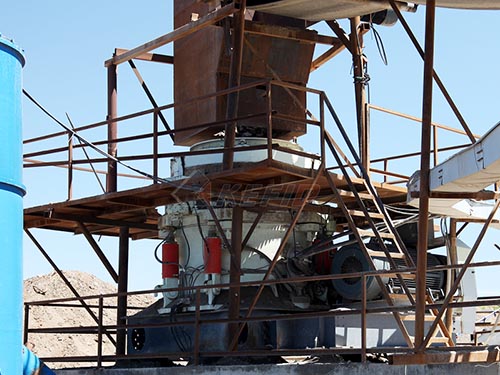
A gyratory crusher is a stationary primary compression crusher, central to largescale mining and aggregate operations. It reduces runofmine ore or quarried rock by compressing it between a fixed concave liner and a gyrating mantle mounted on an oscillating spindle.
Operational Workflow:
1. Feed Intake: Material is fed into the top of the crusher from a dump pocket or directly from haul trucks via a vibrating grizzly feeder.
2. Compression Crushing: The central spindle assembly, with its mounted mantle, gyrates within the stationary concave. This eccentric motion repeatedly compresses the rock against the concave walls.
3. Progressive Reduction: Rock is crushed continuously through multiple compression cycles as it travels down the chamber toward the discharge opening.
4. Discharge Setting Control: The product size is determined by the Closed Side Setting (CSS), adjusted by raising or lowering the spindle assembly hydraulically.
5. Discharge & Conveyance: Crushed material exits through the bottom discharge opening onto a conveyor belt for transport to secondary crushing or stockpiling.
Application Scope & Limitations:
Scope: Ideal for hightonnage (1,500+ TPH) primary crushing applications with hard, abrasive ores (iron ore, copper, gold) or large aggregate feed (>1m). Essential for underground mining installations due to its compact feed entry relative to jaw crushers.
Limitations: Higher capital cost than equivalent jaw crushers. Not suitable for lowtonnage operations (<500 TPH) or highly plastic/sticky materials without modification. Requires a stable concrete foundation and significant headroom for maintenance.
3. CORE FEATURES
Intelligent Hydraulic Control System | Technical Basis: Programmable Logic Controller (PLC) with pressure sensors | Operational Benefit: Enables realtime adjustment of the Closed Side Setting (CSS) and automatic clearing of blockages without manual intervention | ROI Impact: Reduces unplanned downtime by up to 15% and maintains consistent product gradation for downstream optimization
Patented Spider Design | Technical Basis: Archshaped top shell with forged alloy arms | Operational Benefit: Distributes load evenly, eliminates traditional spider arm cracking, and provides secure mounting points for concave segments | ROI Impact: Extends structural service life by decades, eliminating major rebuild costs
Integrated Automatic Tramp Release | Technical Basis: Hydraulic cylinders supporting the main shaft | Operational Benefit: Upon detecting an uncrushable object (tramp iron), the system instantly opens the discharge setting to release it, then automatically returns to original CSS | ROI Impact: Prevents catastrophic damage to head nut and bushings; field data shows a reduction in related downtime events by over 90%
HighPerformance Crushing Chamber | Technical Basis: Computeroptimized chamber profiles (nonchoking/straight) based on feed material simulations | Operational Benefit: Delivers optimal nip angle and crushing action throughout liner life for consistent capacity and product shape | ROI Impact: Increases average throughput by 510% while reducing specific energy consumption (kWh/ton)
Centralized Automated Lubrication | Technical Basis: Dualpath oil circulation system with temperature monitoring and filtration | Operational Benefit: Ensures positive oil flow to all critical bearings (eccentric, step, piston) under all loads; alerts operators to potential issues before failure | ROI Impact: Extends bearing lifecycle by up to 40%, reducing spare parts inventory cost
Wear Component Metallurgy | Technical Basis: Austenitic Manganese Steel (AMS) or proprietary alloy concaves/mantles with optimized heat treatment | Operational Benefit: Provides maximum workhardening capability under impact abrasion for extended wear life in specific ore types | ROI Impact: Lowers costperton crushed for wear parts; industry testing demonstrates 2030% longer life compared to standard AMS in granite applications
4. COMPETITIVE ADVANTAGES
| Performance Metric | Industry Standard Baseline | Modern Gyratory Crusher Solution | Advantage (% Improvement) |
| : | : | : | : |
| Availability (%)| 92 94%| 96 98%| +4% relative improvement |
| Liner Change Downtime| ~36 hours| ~24 hours| 33% faster |
| Specific Energy Consumption| Benchmark kWh/ton metric| Optimized chamber design & drive| Up to 8% reduction |
| Mean Time Between Failure (Main Bearings)| ~5 years| ~7 years| +40% extended service life |
| Throughput Consistency (Tonnage Std Dev)| High fluctuation with feed variance| Stable output via intelligent control| Up to 25% variation |
5. TECHNICAL SPECIFICATIONS
Capacity Range: Configurable from 1,500 to over 12,000 metric tons per hour (MTPH), dependent on model, feed size, and material characteristics.
Power Requirements: Main drive motors typically range from 450 kW to over 1 MW (600 1,300 HP). Complete system includes auxiliary drives for lubrication and hydraulic units.
Material Specifications: Main frame fabricated from highstrength steel plate; concaves/mantles available in various grades of manganese steel or chrome iron alloys; major bearings are bronze bushings or rollertype.
Physical Dimensions: Feed opening up to 1,800 mm; total height can exceed 6 meters; installed weight ranges from 250 to over 600 metric tons including base frame.
Environmental Operating Range: Designed for ambient temperatures from 40°C to +50°C. Dust seals protect internal mechanisms; systems can be outfitted for extreme humidity or dusty conditions.
6. APPLICATION SCENARIOS
LargeScale Copper Mine Expansion
Challenge: A Tier1 copper operation needed to increase primary crushed throughput by 25% without expanding their truck dump pocket footprint or conveyor infrastructure due to space constraints.
Solution: Implementation of a new highcapacity gyratory crusher featuring an optimized straightchamber design that allowed for a finer initial product size while maintaining throughput targets within existing physical limits.
Results: Achieved a sustained throughput increase of 28%. The finer feed improved downstream SAG mill performance by an additional 3%, contributing directly concentrator recovery rates.
Granite Aggregate Quarry Modernization
Challenge: A major quarry faced unsustainable maintenance costs and weekly production delays due to frequent liner changes on aging primary crushers processing highly abrasive granite.
Solution: Replacement with a modern gyratory crusher equipped with proprietary alloy liners designed specifically for granite abrasion resistance and featuring automated hydraulic setting adjustment.
Results:Liner service life increased by an average of two weeks per set.Downtime per change event was reduced by eight hours through improved access design.Total maintenance costs per ton fell by an estimated18%.
7.COMMERCIAL CONSIDERATIONS
Equipment pricing tiers are primarily defined by size/capacity(FEED OPENING)and configuration options:
• Base Model Range:Covers standard duty machines suitablefor most hard rock applications
• HeavyDuty/HighAbrasion Models:Priced at apremium featuring enhanced metallurgyand design factorsfor extreme service
Optional features that impact final investment include:
• Advanced Predictive Maintenance Sensors(vibration temperature oil analysis)
• Fully Automated Wear Compensation Software
• Dual Lubrication System Redundancy
• Specialized Wear Packagefor specific ore types
Service packagesare criticalfor longtermROI:
• Basic Warranty:Covers partsand laborfor defined period
• Extended Service Agreement:Scheduled inspections preventive maintenanceand discounted parts
• Full Performance Contract:Guranteed availability throughputand wear lifewith fixed annual cost
Financing optionsare typically available through manufactureraffiliated partners including capital leases operating leasesor projectbased financing structures tailoredto mine development timelines
8.FREQUENTLY ASKED QUESTIONS(FAQ)
Q:What levelof foundation engineeringis requiredfor installation?
A:A substantial reinforced concrete foundationis mandatory detailed engineering drawingsare providedby themanufacturer Soil bearing capacityand dynamic load calculationsmustbe verifiedby acertified civil engineer prior construction
Q:Cana newgyratory crusherbe integratedwith existing older secondarycrushingor conveying equipment?
A Yes control systemsare designedfor interoperability Moderncrushersinclude programmableI/O(Input/Output)modules thatcanbe configuredto communicatewith mostplantwide SCADAor PLCsystems ensuringoperational synchronization
Q:Whatisthe typical lead timefrom orderto commissioning?
A For standard modelslead timesrange from months dependingon complexity Current global supply chainconditions mandate early engagementwith salesengineeringfor accurate scheduling Longlead itemslike mainshaftcastings often dictate th timeline
Q:Arethere operational training resourcesprovidedforthe crew?
A Comprehensive trainingis standard coveringoperation maintenance lockout/tagout proceduresand basic troubleshooting Thisincludes bothonsite sessionsduring commissioningand accessto digital training modules form future reference
Q Howdoes themanufacturer support part logisticsin remote locations?
A Most OEMs maintainglobal strategically locatedwarehousesfor criticalparts Additionally theyoffer guaranteed inventory programs(kitting)where keywearand repair componentsare heldin stockat regional hubs specificallyforyour site reducingpart deliverytimes significantly