
Quarry Ballast Crushing Equipment Wholesalers Cost

Targeted Content for Commercial Buyers: Quarry Ballast Crushing Equipment
1. Addressing Core Operational Challenges in Ballast Production
Producing consistent, specificationgrade railway ballast is a critical yet demanding task. Inefficient crushing processes directly impact your bottom line through excessive wear, unscheduled downtime, and rejected material. Are you currently managing these challenges?
High Abrasion Costs: The constant grinding of hard, abrasive rock (granite, basalt) leads to rapid wear part consumption. Frequent liner and hammer changes halt production and generate significant ongoing parts expenditure.
Product Shape NonCompliance: Achieving the strict size and shape specifications (e.g., EN 13450, AREMA) for angular, interlocking ballast is difficult. An excess of flaky or elongated particles can lead to load rejection and revenue loss.
Unscheduled Downtime: Equipment failures during critical production windows disrupt supply chains to rail projects, incurring contractual penalties and damaging your reputation as a reliable supplier.
Inefficient Capacity Utilization: Does your primary crusher create a bottleneck? Or does your secondary/tertiary stage struggle to keep up, limiting total plant throughput and leaving potential profit untapped?
High Energy Consumption per Ton: Older crushing circuits with poor chamber design or mismatched components consume excessive power for the final product yield, eroding operational margins.
The central question is: how can you increase reliable tonnage of inspec ballast while systematically reducing cost per ton?
2. Product Overview: HighYield Ballast Crushing Circuits
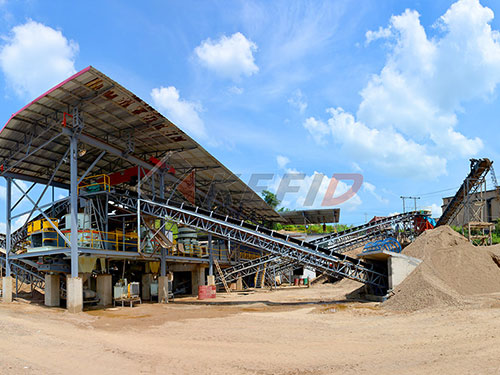
Our engineered solutions for quarry ballast crushing equipment are configured as stationary or modular plants designed specifically for the highvolume production of aggregate for rail infrastructure. The operational workflow is optimized for hard rock reduction:
1. Primary Reduction: Dumpfed primary jaw crusher or gyratory crusher reduces blasted rock to a manageable size (typically <200mm).
2. Secondary Shaping & Sizing: A cone crusher (often of a specific chamber design) performs intermediate crushing, beginning the critical process of creating the desired particle shape.
3. Tertiary/Quarternary Refinement: A vertical shaft impactor (VSI) or highpressure grinding rolls (HPGR) is often employed for final shaping and cubicity optimization, ensuring maximum particle interlock.
4. Precise Screening: Multideck vibrating screens rigorously separate output into precise ballast fractions (e.g., 31.5/50mm, 22/40mm), with oversize material recirculated.
Application Scope & Limitations: This equipment is engineered for hightonnage, continuous operation in quarry environments processing hard, abrasive igneous or metamorphic rock. It is less suited for softer sedimentary rock without specific configuration adjustments and is designed for feed sizes compatible with primary jaw or gyratory crusher openings.
3. Core Features of Our Ballast Crushing Solutions
Our equipment design prioritizes durability, shape control, and operational efficiency.
Advanced Chamber Geometry | Technical Basis: Optimized kinematics & cavity profiles | Operational Benefit: Promotes interparticle crushing in secondary/tertiary stages for superior cubicity and reduced flakiness index | ROI Impact: Higher percentage of premium, specificationcompliant product commands better pricing and reduces waste.
Hydroset CSS Adjustment | Technical Basis: Hydraulic adjustment of the closedside setting on cone crushers | Operational Benefit: Allows operators to finetune product gradation remotely in minutes without stopping the crusher | ROI Impact: Minimizes downtime for size adjustments, increasing plant availability by up to 5% annually.
Wear Part Metallurgy | Technical Basis: Proprietary manganese steel alloys & ceramic composite liners | Operational Benefit: Significantly extends service life in highly abrasive applications, documented to withstand 30% longer intervals between changes | ROI Impact: Lowers costperton for wear parts and reduces frequency of highrisk liner changeout procedures.
Automated Load & Feed Control | Technical Basis: PLCintegrated sensors regulating feed rate based on crusher motor amps | Operational Benefit: Prevents choking and ensures the crushing chamber operates at optimal capacity consistently | ROI Impact: Protects equipment from damage, improves energy efficiency by up to 15%, and maximizes throughput.
Modular Plant Design | Technical Basis: Preassembled skid or modulebased construction | Operational Benefit: Dramatically reduces civil works and installation time on site; allows future reconfiguration or relocation | ROI Impact: Faster timetorevenue from new sites; preserves capital investment value through redeployable assets.
4. Competitive Advantages
Field data from comparable installations demonstrates measurable improvements over standard industry offerings.
| Performance Metric | Industry Standard Benchmark | Our Quarry Ballast Crushing Solution | Documented Advantage |
| : | : | : | : |
| Product Cubicity (% Cubic Particles) | 6575% (Typical ConeOnly Circuit) | 8592% (with VSI/HPRG shaping stage) | +20% Improvement |
| Wear Part Life in Abrasive Rock (MT) | Baseline = 100% | Advanced alloys & design extend life by 3050%| +3050% Improvement |
| Energy Consumption (kWh/Ton) | Varies by rock type; baseline set at 100%| Optimized flow & automation reduces consumption by ~1218%|1218% Reduction |
| Plant Availability (%)| ~8588% (factoring scheduled maintenance)| >92% via quickwear change designs & remote monitoring alerts| +47% Improvement |
5. Technical Specifications
Specifications are modeldependent; below represents a midrange configuration suitable for a ballast quarry producing ~300 TPH.
Design Capacity Range: Configurable from 150 to over 800 metric tons per hour of finished ballast product.
Power Requirements: Primary circuit typically requires 150400 kW; total installed plant power ranges from ~500 kW to 2 MW+ for large installations.
Material Specifications: Engineered for unconfined compressive strength (UCS) of rock >150 MPa. Wear components available in grades for extreme abrasion (Ai >0.5).
Physical Dimensions (Modular Example): Secondary/Tertiary crushing module approx. L16m x W5m x H6m. Fully mobile wheeled options also available.
Environmental Operating Range: Designed for ambient temperatures from 20°C to +45°C with appropriate lubrication systems; dust suppression kit standard.
6. Application Scenarios
Granite Quarry Supplying National Rail Project
Challenge: A major quarry's existing cone crushers produced an excessive proportion of elongated particles (~40%), leading to high recirculation loads (~35%) and failure to meet the project's strict EN 13450 shape requirements consistently.
Solution: Integration of a tertiarystage Vertical Shaft Impactor (VSI) configured specifically for shaping, placed after the secondary cone crusher within our recommended quarry ballast crushing equipment circuit.
Results: Particle cubicity increased from an average of 68% to 89%. Recirculation load dropped to under 20%, increasing net throughput by approximately 18%. The plant consistently met specification on first pass.
Basalt Quarry with High Operating Costs
Challenge: Unscheduled downtime due to premature wear part failure in secondary crushers was causing over 500 hours of lost production annually. Energy costs were also exceeding budget due to an inefficient flow pattern.
Solution: Supply of a configured secondary cone crusher with advanced chamber geometry and proprietary metallurgy liners, paired with an automated feed control system.
Results: Wear part life increased by 40%, reducing annual downtime related to liner changes by ~300 hours. The automated system optimized power draw, yielding a measured 14% reduction in energy cost per ton crushed.
7.Commercial Considerations
We provide scalable solutions aligned with your production targets and capital planning.
Pricing Tiers:
Tier I (Component Upgrade): For existing plant optimization (e.g., new crusher head/VSI rotor). Investment range focused on CapEx below $250k.
Tier II (Modular Section): Addition of a preassembled shaping or screening module ($500k $1.5M).
Tier III (Turnkey Plant): Complete stationary or modular crushing circuit ($2M+), engineered from groundup.
Optional Features: Remote telemetry & predictive analytics packages; advanced dust suppression systems; automated greasing systems; hybrid drive options for energy saving.
Service Packages: Choose from scheduled maintenance plans offering guaranteed parts availability and fixed annual cost models versus comprehensive performancebased contracts that include wear parts coverage linked directly with tonnage produced—a model that aligns our success directly with yours
Financing Options Available including operating leases which preserve working capital as well as traditional finance leases tailored towards longterm asset ownership
8.Frequently Asked Questions
Q1 How do I know if my existing primary feeder/crusher can integrate with your new secondary circuit?
A1 Our engineering assessment includes a full review of your current plant layout feed size distributionand desired output We provide interface drawingsand power load analysis ensure compatibility before any commitment
Q2 What is the typical installation timelinefor modular quarry ballast crushing equipment?
A2 For a skidmounted secondary/tertiary module onsite installation including foundation connectionto existing conveyorsand commissioning typically ranges between46 weeks minimizing production interruption
Q3 Can you guarantee final product will meet our specific rail authority specifications(AREMA EN etc)?
A3 We conduct comprehensive lab testingbased on your source rock samples using our simulation softwareto predict gradationand shape outcomes Performance guaranteeson throughputand product specification are then includedin the contractfor turnkey solutions
Q4 How does financing through an operating leaseaffect my balance sheet?
A4 Payments are typically treated as an operating expense This preserves bank linesof credit keeps debt off the balance sheetand may offer potential tax benefits dependingon jurisdiction Consultyour financial advisorfor specifics
Q5 What operator trainingis provided?
A5 We supply comprehensive trainingfor both maintenance staffand machine operators covering daily checks safe operation troubleshooting procedures Training occurs onsite during commissioningwith detailed manualsprovided digitally