
Mantle Cone Crusher Polysius

The Heart of Crushing Excellence: Unpacking the Mantle in Polysius Cone Crushers
Within the demanding world of mineral processing and aggregate production, achieving efficient size reduction is paramount. Cone crushers stand as pivotal workhorses in secondary and tertiary crushing circuits, tasked with transforming coarse feed into precisely sized product fractions. At the very core of this crushing action lies a critical component – the mantle. When paired with renowned engineering prowess like that of Polysius (now part of thyssenkrupp Industrial Solutions), the mantle transcends being merely a wear part; it becomes a meticulously designed element central to performance optimization, reliability, and cost-effective operation.
Understanding the Crushing Chamber Dynamics
To appreciate the significance of the mantle within a Polysius cone crusher, one must first grasp its role within the crushing chamber:
1. The Essential Duo: The crushing chamber is formed by two essential surfaces:
The Concave (or Bowl Liner): This is a stationary manganese steel liner fixed within the upper frame (bowl) of the crusher.
The Mantle: This is a moving manganese steel liner mounted on the main shaft assembly (head). It gyrates eccentrically within the concave due to rotation imparted by gears driven by an electric motor via countershafts.
2. The Crushing Action: As material enters from above into the annular space between the concave and mantle:
The rotating eccentric causes the main shaft assembly (and thus the mantle) to perform a gyratory precession motion relative to the stationary concave.
This motion creates a constantly changing gap between mantle and concave surfaces – wider at one point for feeding material down into it ("open side setting"), narrowing progressively towards another point where compression occurs ("closed side setting").
Material trapped within this narrowing gap experiences compressive forces as well as inter-particle attrition until its fracture strength is exceeded.
Once sufficiently reduced in size near or at CSS), gravity allows particles to escape through discharge openings at bottom of chamber.
3. Mantle Profile Dictates Performance: The shape – or profile – of both concave & mantle liners defines:
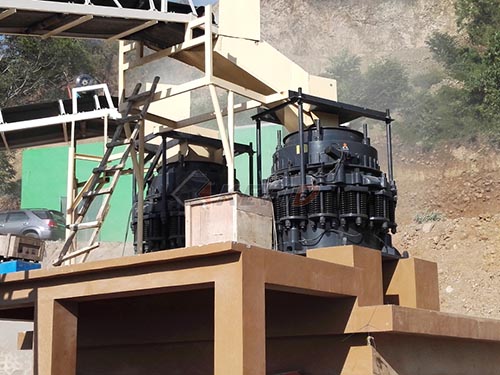
Crushing Cavity Geometry: Influences how material flows through chamber & compression angles applied.
Product Gradation: Steeper profiles produce finer product; flatter profiles favor coarser output & higher capacity.
Capacity