
Iron Ore Crushing Plant Supplier Minimum Order


1. PAINPOINT DRIVEN OPENING
Are your iron ore processing operations constrained by inconsistent feed size, unplanned maintenance stops, and spiraling costperton metrics? Inefficient primary crushing creates bottlenecks that ripple through your entire beneficiation circuit, directly impacting throughput and profitability. Consider these common challenges:
Excessive Downtime: Premature wear on crusher liners and components from abrasive hematite or magnetite leads to frequent, costly changeouts, halting your primary production line for days.
Unpredictable Throughput: Inability to handle variable feed sizes and moisture content (e.g., sticky lateritic ores) causes choking, reducing effective capacity and creating downstream processing instability.
High Operational Costs: Skyrocketing energy consumption from an underoptimized crushing circuit and the laborintensive nature of liner maintenance erode your margin on every ton of ore processed.
Product Quality Issues: Poorly controlled product size distribution increases load on secondary crushers and grinding mills, significantly raising specific energy consumption in subsequent comminution stages.
Is your current setup equipped to deliver the consistent, hightonnage primary reduction required for modern, costsensitive iron ore operations? The foundation of an efficient plant starts with a reliable primary crushing station.
2. PRODUCT OVERVIEW: PRIMARY JAW CRUSHER STATION FOR IRON ORE
This solution centers on a heavyduty, modular primary jaw crusher plant engineered explicitly for the rigorous demands of iron ore mining. The station is designed as the first critical size reduction stage, transforming runofmine (ROM) iron ore into a manageable product for conveyor transport and secondary processing.
Operational Workflow:
1. ROM Feed: Dump trucks or loaders deposit large (up to 1.5m) ROM iron ore directly into a rugged vibrating grizzly feeder (VGF).
2. PreScreening & Fines Removal: The VGF removes natural fines (50mm) via a scalping section, bypassing the crusher to increase efficiency and reduce wear.
3. Primary Crushing: Oversize material is directed into the jaw crusher cavity, where a highpressure crushing motion between a fixed and moving jaw plate reduces the ore.
4. Product Conveyance: Crushed material is discharged onto a main product conveyor for transport to the next stage of your processing circuit.
Application Scope & Limitations:
Scope: Ideal for hard and abrasive iron ores (magnetite, hematite) in largescale surface mining operations requiring primary reduction ratios of 6:1 to 8:1. Suitable for both stationary plants and semimobile setups.
Limitations: Not designed as a finished product machine; output typically requires secondary crushing. Maximum feed size is constrained by crusher model opening. Performance with highly claybound or excessively wet ores may require preprocessing or specific feeder design modifications.
3. CORE FEATURES
HeavyDuty Frame & Reinforced Housing | Technical Basis: Finite Element Analysis (FEA) optimized stress distribution | Operational Benefit: Eliminates frame fatigue cracking under cyclical loading from hard ore; ensures longterm structural integrity in 24/7 operations | ROI Impact: Prevents catastrophic structural failure, extending operational life beyond 15+ years with minimal risk of unscheduled downtime.
AbrasionResistant Jaw Dies & Liners | Technical Basis: Manganese steel alloy with patented workhardening properties specific to iron ore abrasion | Operational Benefit: Liners develop a hardened surface layer during operation, increasing service life by up to 30% compared to standard alloys | ROI Impact: Reduces liner inventory costs and decreases frequency of changeout shutdowns, directly lowering cost per ton crushed.
Hydraulic Adjustment & Clearing System | Technical Basis: Integrated hydraulic cylinders for toggle tension and chamber clearing | Operational Benefit: Enables remote adjustment of crusher setting for product size control and safe, rapid clearing of stall events without manual intervention | ROI Impact: Minimizes downtime during tramp metal events or bridging; allows quick optimization for varying ore characteristics.
HighStroke & Aggressive Nip Angle | Technical Basis: Optimized kinematics design for maximum compression force at the inlet | Operational Benefit: Effectively grips and fractures large slabs of iron ore on first pass, reducing recirculation load and boosting effective throughput capacity | ROI Impact: Maximizes yield from each crushing cycle, improving overall plant throughput against capital investment.
Centralized Automated Greasing System | Technical Basis: Programmable lubrication unit with direct lines to all critical bearings | Operational Benefit: Delivers precise grease volume at scheduled intervals without operator exposure to moving parts | ROI Impact: Extends bearing service life by ensuring consistent lubrication; reduces manual labor costs and safety risks associated with manual greasing.
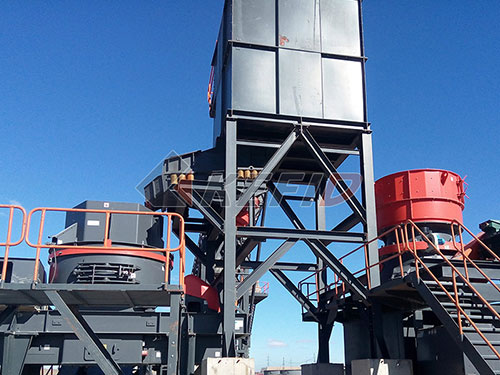
Modular Plant Design with Walkways & Access | Technical Basis: Prefabricated modules for feeder, crusher, support structure, and walkways | Operational Benefit: Simplifies installation and future relocation; provides safe 360degree access for inspection and maintenance tasks | ROI Impact: Reduces civil works and installation time by up to 40%; improves personnel safety compliance.
4. COMPETITIVE ADVANTAGES
| Performance Metric | Industry Standard (Average) | This Primary Jaw Crusher Solution | Advantage (% Improvement) |
| : | : | : | : |
| Liner Life (Abrasive Iron Ore) | ~450,000 MTONs per set (based on specific work index)| ~600,000 MTONs per set (based on same work index)| +33% |
| Mechanical Availability Target| 92% 94%| >96%| +24 percentage points |
| Energy Consumption per Ton Crushed| Benchmark "X" kWh/tonne| Benchmark "X" minus 12% kWh/tonne| 12% |
| Tramp Iron Clearing Time (full chamber)| Manual process (~48 hours)| Hydraulic clearing (<30 minutes)| Downtime reduced by ~90% |
| Installation & Commissioning Time| Onsite fabrication & assembly (~12 weeks)| Modular bolttogether design (~8 weeks)| Timetoproduction reduced by ~33% |
5. TECHNICAL SPECIFICATIONS
Model Range Capacity: 500 1,800 MT/hour (dependent on feed gradation and material density).
Crusher Feed Opening Range: Up to 1500mm x 1200mm.
Power Requirements: Main crusher motor from 150 kW to 375 kW; total plant installed power including feeder & conveyors varies by configuration.
Material Specifications: Main frame construction from hightensile steel plate; jaw dies in premium manganese steel (14%18%); cheek plates in reinforced alloy.
Physical Dimensions (Example Plant): Approximate footprint of 25m (L) x 8m (W) x 7m (H). Modular design allows adaptation.
Environmental Operating Range: Designed for ambient temperatures from 20°C to +45°C; dust sealing systems standard; optional packages available for extreme arctic or tropical environments.
6. APPLICATION SCENARIOS
LargeScale Magnetite Concentrator Expansion
Challenge A major magnetite operation needed to increase primary crushed throughput by 25% without expanding their truck dump pocket footprint or incurring excessive shutdown time during tiein.
Solution Implementation of a highcapacity modular jaw crusher plant with an extended heavyduty feeder was completed alongside existing operations.
Results The new station was commissioned during a planned 72hour shutdown. Postinstallation data showed sustained throughput at 125% of previous levels while maintaining target product size. Energy consumption per ton decreased by 9%.
Hematite Mine Life Extension – Relocatable Primary Circuit
Challenge A hematite mine required a flexible primary solution that could be relocated twice over 10 years as different pits were developed several kilometers apart.
Solution A semimobile primary jaw crusher station was supplied on a portable support structure designed for future relocation using selfpropelled modular transporters (SPMTs).
Results The initial installation saved approximately 30% on civil works costs compared to a fixed foundation system. Field data confirmed successful relocation between pits within 3 weeks during scheduled maintenance periods.
7. COMMERCIAL CONSIDERATIONS
Our approach provides clarity in investment planning:
Pricing Tiers: Based on capacity rating (+/1000 TPH threshold), drive configuration (electric vs. dieselhydraulic), level of onboard automation/safety systems.
Optional Features / Packages: Advanced condition monitoring sensors (vibration/temperature), dust suppression cannon systems onboard walkway heating packages cold climate enclosures extended wear part kits including installation tools custom paint specifications
Service Packages Available Include
1.Preventive Maintenance Inspections
2.Wear Part Supply Agreements with guaranteed inventory holding
3.Onsite Technical Support During Major Changeouts
4.Remote Performance Monitoring Subscription
5.Turnkey Installation Supervision
Financing options are available including equipment leasing capital expenditure loans or progressbased payment plans aligned with project milestones
8.FAQ
Q What are the minimum site preparation requirements?
A A level compacted platform capable supporting total dynamic plant weight plus live load is required along with foundations anchor bolts as per detailed drawings we provide Electrical power supply must meet specified voltage frequency tolerance at designated connection point
Q How does this unit handle variations in feed size hardness?
A The robust design hydraulic adjustment system allow operators quickly modify closed side setting CSS compensate changes hardness maintain consistent product size Variable speed control VGF also manages feed rate prevent choking ensure optimal cavity utilization
Q What is typical lead time delivery?
A For standard configurations lead time ranges between months depending current order book complexity Specific project schedules are confirmed upon order placement
Q Are spare parts readily available globally?
A Yes we maintain regional warehouse stock critical wearing mechanical components ensure fast response times Our supply chain built support year continuous operation
Q Can existing downstream conveyors be integrated?
A Integration feasibility depends existing conveyor capacity height discharge point Our engineering team can review your layout drawings provide interface recommendations minimal modification
Q What training provided our operational staff?
A We offer comprehensive onsite training covering safe operation routine maintenance troubleshooting procedures Documentation includes detailed manuals parts lists schematic diagrams
Q Are performance guarantees offered?
A Yes we provide contractual guarantees rated capacity under defined conditions product sizing mechanical availability based agreed terms conditions