
Industrial Stamp Mill Gold Mining Importers


1. PAINPOINT DRIVEN OPENING
Are you managing gold recovery operations burdened by inconsistent throughput, excessive maintenance costs, and suboptimal mineral liberation? Legacy crushing and grinding circuits can create significant bottlenecks, directly impacting your bottom line. Consider these common challenges:
Recovery Losses: Inefficient particle size reduction fails to fully liberate gold from complex ores, leaving valuable material in tailings.
Unscheduled Downtime: Frequent breakdowns of underengineered stamp mills or primary crushers halt entire processing lines, costing thousands per hour in lost production.
High Operational Costs: Excessive energy consumption per ton processed, coupled with high wear part replacement frequency and laborintensive operation, erodes profit margins.
Inconsistent Output: Variable feed size or hardness leads to fluctuating grind coarseness, complicitating downstream cyanidation or gravity recovery processes.
Is your operation seeking a reliable, highcapacity solution to achieve consistent, optimal grind size for maximum gold recovery? The industrial stamp mill remains a proven technology for specific applications, and modern importers provide advanced models designed to address these exact pain points.
2. PRODUCT OVERVIEW
The Industrial Stamp Mill is a heavyduty mechanical crushing device designed for the coarse to intermediate grinding of goldbearing quartz rock and other ores. Its core function is to liberate gold particles through repeated percussive action, preparing material for subsequent fine grinding or direct chemical processing.
Operational Workflow:
1. Feed Introduction: Runofmine (ROM) ore or primarycrushed rock is fed into a sturdy mortar box.
2. Percussive Crushing: A set of mechanically lifted heavy stamps (weighted rods with hardened shoes) are alternately dropped onto the ore bed.
3. Size Classification: Crushed material passes through a screen grate at the mortar box discharge; oversized particles remain for further crushing.
4. Slurry Discharge: Finer material exits as a slurry, typically directed to shaking tables or fine grinding circuits for further concentration.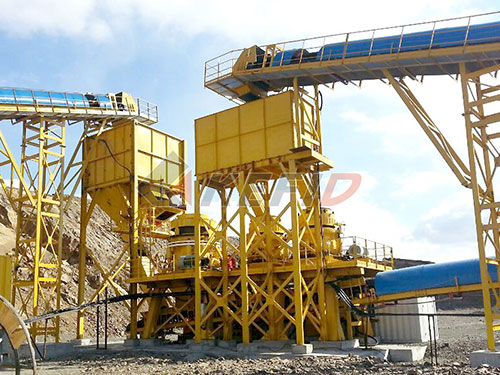
Application Scope & Limitations:
Ideal For: Hard rock gold ore (quartz), pilot plants, smalltomedium scale operations (50500 TPD), and regions with limited access to complex milling technology.
Limitations: Not suitable for soft or clayrich ores (causes packing), requires consistent feed sizing (<2"), generally less energyefficient than modern ball mills for highvolume fine grinding.
3. CORE FEATURES
Modular Frame Construction | Technical Basis: Prefabricated, hightensile steel sections bolted onsite | Operational Benefit: Reduces installation time by up to 40%, allows for future plant reconfiguration or expansion | ROI Impact: Lower capital installation costs and enhanced longterm operational flexibility.
Segmented Wear Shoes | Technical Basis: Individually replaceable hardened alloy crushing surfaces on each stamp | Operational Benefit: Isolate wear to specific components; change single shoes in under 30 minutes without dismantling the stamp assembly | ROI Impact: Cuts maintenance downtime by over 50% and reduces spare parts inventory cost.
Variable Camshaft Control | Technical Basis: Adjustable cam profiles governing lift height and drop frequency of stamps | Operational Benefit: Operators can finetune impact energy and rhythm based on ore hardness and feed rate for optimal liberation | ROI Impact: Improves recovery yield by ensuring consistent target particle size distribution.
Integrated Water Flush System | Technical Basis: Pressurized water injection ports within the mortar box | Operational Benefit: Prevents dust, continuously evacuates fines to prevent overgrinding and packing, maintains steady slurry density | ROI Impact: Increases throughput capacity by 1525% and improves downstream recovery efficiency.
Centralized Grease Lubrication | Technical Basis: Automated manifold delivering grease to all major bearings and cam faces on a timed cycle | Operational Benefit: Eliminates manual lubrication points, ensures critical components are protected from abrasive dust | ROI Impact: Extends bearing service life by 3x, reducing unscheduled failures and associated downtime costs.
4. COMPETITIVE ADVANTAGES
| Performance Metric | Industry Standard (Legacy Stamp Mills) | Modern Imported Stamp Mill Solution | Advantage (% Improvement) |
| : | : | : | : |
| Availability / Uptime | ~85%, frequent manual bearing failures | >94%, with automated lubrication & sealed bearings| +9% (+~500 hrs/year) |
| Tonnage per Wear Part Cost| $X per ton processed| $0.7X per ton processed| 30% operational cost |
| Energy Efficiency (kWh/ton)| Varies widely; often unoptimized| Up to 20% reduction via optimized drive & cam design| 20% power cost |
| Installation & Commissioning Time| 46 weeks with extensive field welding| 23 weeks with modular boltup design| 50% timetoproduction |
5. TECHNICAL SPECIFICATIONS
Model Range & Capacity: Available in 5stamp to 20stamp configurations; throughput from 0.5 to 5+ tons per hour per stamp, depending on ore characteristics.
Power Requirements: Electric motor driven; typical installed power from 75 kW (5stamp) to 350 kW (20stamp). Configured for 380V480V/5060Hz industrial threephase.
Material Specifications: Mortar box liners: ASTM A532 Class III Hardened Chrome Iron. Stamps: Highcarbon steel shafts with forged alloy steel heads. Wear Shoes: Manganese Steel or Chrome White Iron.
Physical Dimensions (20Stamp Mill Example): Footprint approx. 8m L x 4m W x 6m H (excluding feed hopper).
Environmental Operating Range: Designed for ambient temperatures from 10°C to +45°C. Dust suppression system standard for compliance with enclosed plant requirements.
6. APPLICATION SCENARIOS
MidScale Hard Rock Mine, West Africa | Challenge: Existing jaw crusher produced slabby output with excessive fines, causing poor performance in downstream ball mill and estimated 812% gold lockup in coarse tailings.| Solution: Installation of a tenunit industrial stamp mill circuit between primary crushing and ball milling to generate a more consistent, cubical product.| Results: Achieved target grind size more efficiently. Overall plant recovery increased by 5%, paying back the stamp mill investment in under 14 months through additional gold production.
Artisanal & SmallScale Mining (ASM) Cooperative Upgrade, South America | Challenge: Manual crushing methods were inefficient, hazardous, and limited processing volume to <10 TPD.| Solution: Implementation of a containerized fiveunit industrial stamp mill plant with integrated feed conveyor and safety guards.| Results: Processing capacity increased to 50 TPD in a controlled environment. Gold recovery rates improved from an estimated <60% to over 85%, dramatically improving cooperative revenue while meeting formalization safety standards.
7. COMMERCIAL CONSIDERATIONS
Pricing Tiers: Capital cost is typically structured per stamp unit.
Base Equipment Package (Mill structure,cams,motors)
Complete Circuit Package (+feed system,sump,pumps,basic controls)
Turnkey Plant Package (+foundations,support steel,electricians)
Optional Features & Upgrades: Advanced PLC monitoring systems for predictive maintenance; special alloy wear packages for highly abrasive ores; sounddampening enclosures; slurry density automation systems.
Service Packages: Standard offerings include commissioning supervision; comprehensive operator training programs; annual inspection contracts; guaranteed spare parts availability kits.
Financing Options: Reputable importers often work with export credit agencies or international trade banks to offer leasetoown structures or equipment financing over terms of upto five years
8.FAQ
1.Q:What is the ideal maximum feed size for an industrial stamp mill?
A.For optimal operation and minimal shoe wear,the top size of feed material should not exceed two inches(50mm).A primary jaw crusher is typically recommended upstream
2.Q.Can this equipment be integrated into an existing carboninleach(CIL)or carboninpulp(CIP)plant?
A Yes Industrial stamp mills serve as an effective primary or secondary crushing stage.They produce a consistent slurry that can be fed directly into a fine grinding ball mill which then feeds your leaching circuit improving overall liberation ahead of the tanks
3.Q.What are the lead times for deliveryand what support is provided during installation?
A Lead times vary but range from12to24weeks exworks.Comprehensive installation manuals are provided,and most suppliers include optional onsite commissioning supervision by a field engineer within the purchase price
4.Q.How does operational cost compareto using onlya jaw crusherand cone crusher circuit?
A While capital cost may be lowerfor astampmill versusacone crusherfor comparable capacity,the key comparisonisintotalrecovery.Thestampingactioncanimprove liberationoncomplexveinmaterialpotentiallyyieldinghigher overallrecoverythatoutweighs marginallyhigherpertonenergycosts
5.Q.Whatisthetypicallifespanofcriticalwearcomponents?
A Fielddatashowsmortarboxlinerslasting12to18monthsincontinuousoperationwithabrasiveore.Wearshoesrequire replacementevery4to8weeksdependingonorehardnessandthroughputTheseareconsideredstandardoperatingconsumables
6.Q.Arethesemills suitableforremote siteswithlimitedpowerinfrastructure?
A Dieseldrivenversionsareavailableformodelsupto10stampsprovidingoperationalindependencewheregridpowerisunreliableorunavailable
7.Q.Whatkindoftrainingismandatoryforsafeandefficientoperation?
A Trainingencompassessafetyshutdownproceduresroutineinspectionpointsforwearcomponentadjustmentproperfeedratecontrolandbasic troubleshootingSupplierledtrainingisstronglyrecommendedtoguaranteeperformance