
Gold Ore Crushing Equipment Supplier Delivery

1. PAINPOINT DRIVEN OPENING
Are your gold processing operations constrained by inefficient primary size reduction? Inconsistent feed size, excessive liner wear, and unplanned maintenance stops directly impact your bottom line. Consider these common challenges:
High Operational Cost: Premature failure of crusher wear parts leads to frequent, costly replacements and significant labor downtime.
Throughput Bottlenecks: Inadequate crushing capacity or poor product sizing can choke downstream milling circuits, limiting overall plant recovery.
Unreliable Uptime: Mechanical failures in harsh environments cause unpredictable shutdowns, jeopardizing production targets.
Energy Inefficiency: Older or poorly configured crushing equipment consumes excessive power per ton of ore processed, eroding margins.
Is your primary crushing stage a source of variable cost and operational uncertainty? The right gold ore crushing equipment is not merely a purchase; it is a strategic investment in plant stability and profitability.
2. PRODUCT OVERVIEW: PRIMARY JAW CRUSHER FOR GOLD ORE PROCESSING
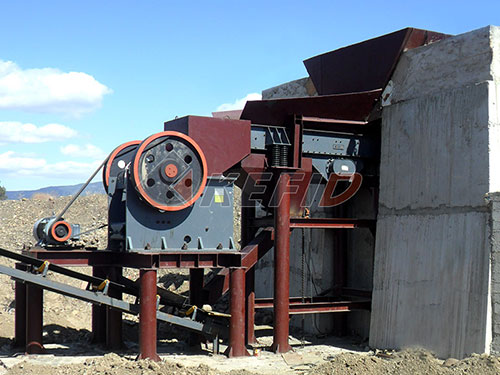
This heavyduty gold ore crushing equipment is engineered as a robust primary jaw crusher for the initial size reduction of runofmine (ROM) goldbearing rock. Its design prioritizes reliability and efficiency in demanding mineral processing applications.
Operational Workflow:
1. ROM ore is fed into the vibrating grizzly feeder (optional), which bypasses fines to reduce crusher load.
2. Oversize material enters the crusher’s fixed jaw and moving jaw chamber, where compressive force breaks the ore.
3. The crushed product discharges at a preset closedside setting (CSS), determining the maximum output size for the secondary crushing or milling circuit.
Application Scope: Ideal for hard rock gold ores (quartz, sulphides), this equipment handles abrasive materials with high compressive strength. It serves as the first critical stage in comminution circuits for both stationary plants and semimobile installations.
Limitations: Not designed for wet, sticky ores without proper feed system modifications. Ultimate capacity is dependent on feed size distribution, material hardness (Wi), and desired reduction ratio.
3. CORE FEATURES
Deep Crushing Chamber & Aggressive Nip Angle | Technical Basis: Optimized kinematics and chamber geometry | Operational Benefit: Enables higher throughput and effective reduction of large feed material | ROI Impact: Increases processed tonnage per operating hour, improving asset utilization
HeavyDuty Roller Bearing Design | Technical Basis: Spherical selfaligning roller bearings with large diameter shafts | Operational Benefit: Provides high load capacity and reliable operation under shock loads | ROI Impact: Extends bearing service life, reduces failure risk and associated downtime costs
Modular Jaw Die Design | Technical Basis: Segmented, reversible manganese steel wear plates | Operational Benefit: Allows for selective replacement of worn sections and rotation for extended service life | ROI Impact: Lowers consumable costs by up to 30% compared to singlepiece die systems
Hydraulic Toggle Adjustment System | Technical Basis: Integrated hydraulic cylinder for CSS adjustment and overload relief | Operational Benefit: Enables quick, safe setting changes without manual shims; protects against tramp metal | ROI Impact: Minimizes adjustment downtime from hours to minutes; prevents major damage from uncrushables
Reinforced Fabricated Steel Frame | Technical Basis: Stressrelieved frame with heavyduty ribbing | Operational Benefit: Maintains structural integrity under constant cyclic loading in remote locations | ROI Impact: Ensures longterm alignment and durability, protecting the core capital investment
4. COMPETITIVE ADVANTAGES
| Performance Metric | Industry Standard (Average) | This Gold Ore Crushing Solution | Advantage (% Improvement) |
| : | : | : | : |
| Manganese Wear Life (Abrasive Ore) | 120,000 150,000 MT | 180,000 220,000 MT | +40% Extended Service |
| Power Consumption per Ton Crushed| 0.8 1.1 kWh/t | 0.65 0.85 kWh/t| 22% Energy Efficiency |
| Mechanical Availability (Scheduled) | 9294%| 9698%| +4 Percentage Points Uptime |
| CSS Adjustment Time| 6090 minutes| <10 minutes| 85% Faster Changeover |
5. TECHNICAL SPECIFICATIONS
Capacity Range: 350 1,200 MTPH (dependent on feed gradation & material characteristics)
Feed Opening: 1,070mm x 760mm (42" x 30")
Power Requirement: 110150 kW electric drive motor
Material Specifications: Highstrength quenched & tempered steel frame; ASTM A128 Manganese steel jaw dies; SAE 4140 forged eccentric shaft.
Physical Dimensions (LxWxH): ~6.5m x 3.2m x 3.4m
Operating Range: Designed for ambient temperatures from 20°C to +45°C; dustprotected critical components.
6. APPLICATION SCENARIOS
Hard Rock Gold Mine, West Africa | Challenge: Frequent jaw die failures on existing crusher due to highly abrasive quartzite ore were causing monthly stoppages and high spare part costs.| Solution: Implementation of this primary jaw crusher with modular manganese dies and optimized liner profile.| Results: Wear part life extended from ~110k tons to over 190k tons recorded; crusherrelated downtime reduced by an average of 18 hours per month.
MidScale Processing Plant, North America| Challenge: Need to increase circuit throughput by ~25% without a complete plant rebuild; existing primary crusher was a bottleneck.| Solution: Installation of this highercapacity jaw crusher with a deeper chamber to handle larger ROM feed from the pit.| Results: Sustained average throughput increased by 28%; product P80 consistently met target for optimal SAG mill feed.
7. COMMERCIAL CONSIDERATIONS
Equipment pricing is structured around configuration tiers:
Base Unit: Includes core crusher with standard motor drives and starter.
SkidMounted Package: Base unit preassembled on a structural steel skid with integral walkways and ladders for faster installation.
Modular Plant Section: Crusher integrated with matched feeder, discharge conveyor, dust suppression system, and electrical control panel.
Optional features include automated lubrication systems, wear monitoring sensors, and custom liner profiles for specific ore types.
Service packages range from basic commissioning support to comprehensive multiyear maintenance agreements covering planned inspections and priority parts supply.
Financing options include capital purchase with standard warranty or operational expenditure models such as leasing agreements with fullservice support included.
8. FAQ
Q1: Is this gold ore crushing equipment compatible with our existing secondary cone crusher circuit?
Yes. The discharge product gradation can be precisely controlled via the hydraulic CSS adjustment to create an optimal feed size distribution for your specific secondary stage.
Q2: What is the expected operational impact on our maintenance team?
Field data shows reduced frequency of liner changes and simplified procedures due to the modular die design and hydraulic toggle system. This typically reallocates maintenance hours from reactive repairs to planned preventive tasks.
Q3: How does the equipment handle variations in ore hardness within our deposit?
The heavyduty construction and hydraulic overload protection are designed specifically for such fluctuations. The system will automatically release uncrushable material while maintaining safe operating pressures through varying rock strengths.
Q4:What are typical lead times for delivery?
Lead times vary based on configuration complexity but are typically within XY weeks upon order confirmation due to standardized modular manufacturing processes.
Q5:What commercial terms are available?
We offer ExWorks pricing alongside CIF options depending on destination port requirements related to international shipping logistics associated with industrial machinery transport schedules