
China Sand Gravel Mining Processing Plant


1. PAINPOINT DRIVEN OPENING
Managing a sand and gravel operation means contending with persistent challenges that directly erode profitability. Are you experiencing:
High Operational Downtime: Frequent mechanical failures in crushers or screens, leading to production halts that can cost thousands per hour in lost output.
Inconsistent Product Gradation: Offspec material that fails to meet project specifications, resulting in product rejection, reprocessing costs, and damaged client relationships.
Excessive Wear Part Costs: Premature failure of liners, screens, and impellers due to abrasive silica content, creating unpredictable maintenance budgets and parts inventory burdens.
Inefficient Water & Fines Management: Ineffective separation leading to loss of saleable fines, high water consumption, and complex settling pond management.
Rising Energy Costs: Older, singlespeed processing plants consuming excessive power per ton of salable aggregate produced.
The central question for plant managers is this: how can you implement a processing solution that systematically addresses these issues to deliver predictable throughput, consistent quality, and controlled operational expenditure?
2. PRODUCT OVERVIEW
A modern stationary sand gravel mining processing plant is an integrated circuit of crushing, screening, washing, and material handling equipment engineered for highvolume aggregate production. Its operational workflow is designed for continuous material flow:
1. Primary Size Reduction: Runofquarry (ROQ) feed is reduced by a primary crusher (e.g., jaw or gyratory).
2. Classification & Secondary Reduction: Material is screened; oversize is routed to secondary/tertiary cone or impact crushers for further reduction.
3. Washing & Scrubbing: Crushed aggregate is fed into log washers or scrubbers to remove clay, silt, and organic matter.
4. Final Sizing & Dewatering: Material passes through final sizing screens; sand products may be routed to cyclones or dewatering screens for moisture control.
5. Stockpiling & Loadout: Sized products are conveyed to designated stockpiles for loadout.
This solution is applicable for medium to largescale aggregate deposits with a lifespan justifying fixed infrastructure investment. It is less suitable for small reserves or highly mobile mining requirements where portable plants are preferred.
3. CORE FEATURES
Modular Plant Design | Technical Basis: Preengineered, skidmounted sections with standardized connections | Operational Benefit: Reduces site installation time by up to 40%, minimizes civil works and onsite welding | ROI Impact: Faster commissioning accelerates revenue generation; modularity allows for future circuit expansion.
Advanced Automation Control System | Technical Basis: Centralized PLC with SCADA interface monitoring amp draws, feed rates, and tank levels | Operational Benefit: Operators optimize feed for chokefed crushing and monitor plant health in realtime from a single control room | ROI Impact: Consistent operation maximizes yield; predictive alerts prevent catastrophic component failure.
HighEfficiency Sand Washing & Recovery | Technical Basis: Cyclonebased classification with integrated fine material screw washers or dewatering screens | Operational Benefit: Recovers up to 95% of +200 mesh sand typically lost in settling ponds; produces lowmoisture spec sand | ROI Impact: Transforms waste into product; significantly reduces pond dredging costs and water makeup requirements.
AbrasionResistant Material Specification | Technical Basis: Use of AR400 steel liners, highchrome white iron wear parts, and polyurethane screen media in critical wear zones | Operational Benefit: Extends service life of wear components in highly abrasive silica environments by 3060% | ROI Impact: Lowers costperton for wear parts; increases mean time between failures (MTBF) for planned maintenance.
Variable Frequency Drive (VFD) Integration | Technical Basis: VFDs on major motors for conveyors, pumps, and crushers allow softstart and speed adjustment | Operational Benefit: Reduces inrush current stress on electrical systems; allows precise tuning of feeder speeds for optimal crusher cavity fill | ROI Impact: Cuts peak power demand charges; improves overall energy efficiency per processed ton.

4. COMPETITIVE ADVANTAGES
| Performance Metric | Industry Standard Baseline | Our Sand Gravel Processing Plant Solution | Documented Advantage |
| : | : | : | : |
| Overall Availability (Scheduled Runtime) | 8590% | 9295%+ | +5% improvement |
| Fines Recovery Efficiency (+200 mesh) | 7080% loss to ponds/effluent| Up to 95% recovery as product| Converts ~20% of waste stream |
| Wear Cost per Ton Processed (Abrasive Rock) $X.XX/ton| $X.XX/ton| Up to 25% reduction |
| Water Consumption per Ton Washed| X gallons/ton| X gallons/ton| Up to 15% reduction via closedloop systems |
| Installation & Commissioning Timeline| Y weeks| Y weeks| Up to 30% faster due to modular design |
5. TECHNICAL SPECIFICATIONS
Design Throughput Capacity: Configurable from 150 TPH to 800+ TPH of raw feed.
Power Requirements: Plantwide demand from 500 kVA to 2 MVA+; designed for mains grid connection with options for onsite generation tiein.
Primary Crusher Options: Jaw Crusher (900mm x 600mm up to 1500mm x 1300mm) or Primary Gyratory.
Secondary/Tertiary Circuit Options: Cone Crushers (200 HP up to 750 HP) and/or Vertical Shaft Impactors (VSI) for shaped aggregates/manufactured sand.
Material Specifications: Major structural components fabricated from ASTM A36 steel; critical wear components in AR400 steel or equivalent chromium alloys.
Physical Footprint: Varies by configuration; typical modular plant requires a prepared pad of approximately 80m L x 40m W.
Environmental Operating Range: Designed for ambient temperatures from 20°C to +45°C; dust suppression systems standard; noise abatement enclosures optional.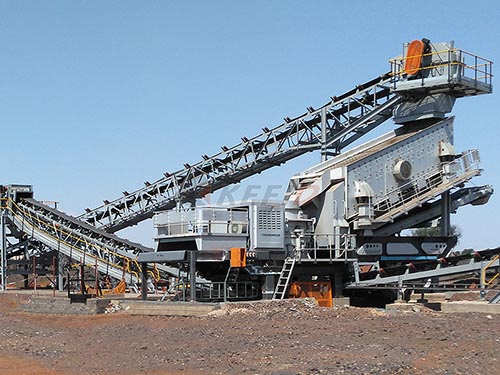
6. APPLICATION SCENARIOS
Concrete Aggregate Producer Challenge:
A regional producer faced increasing rejections of washed concrete sand due to inconsistent gradation and high moisture content causing batching issues.
Solution:
Implementation of a processing plant featuring a dedicated VSI crusher for fines shaping and a highfrequency dewatering screen with cyclone preclassification.
Results:
Product consistency achieved >98% pass rate on spec; moisture content reduced from >8% to stable <5%; sales price premium secured for guaranteedspec material.
Alluvial Gravel Pit Operator Challenge:
An operator struggled with inefficient clay removal leading to poor particle coating and low prices for their gravel products, alongside rapidly filling settling ponds.
Solution:
Integration of a heavyduty clay scrubber module prior to primary screening and conversion from pondbased settling to a compact hydrocyclone/screw washer system.
Results:
Clay content reduced from >3% to <0.5%; eliminated seasonal pond dredging operations; recovered an additional 50 TPH of saleable fine sand previously lost.
7. COMMERCIAL CONSIDERATIONS
Our sand gravel mining processing plants are offered under clear commercial frameworks:
Pricing Tiers:
Tier I (Standardized Modular Plant): Fixedscope solution based on proven layouts for common applications.
Tier II (ConfiguredtoOrder): Customization of standard modules for specific feed material or product blend requirements.
Tier III (Full Custom Design): Engineeredfromscratch solutions for unique geological deposits or extreme capacity needs.
Optional Features: Dust encapsulation packages, sound attenuation cabins, automated lubrication systems, advanced particle size monitoring cameras.
Service Packages: Extended warranty plans, guaranteed wear part life programs (costperton contracts), remote diagnostics subscriptions.
Financing Options: Equipment leasing through partners, project financing solutions tailored greenfield developments,
8. FAQ
1. Q Can this plant be integrated with our existing primary crusher or washing system?
A Yes,
2.Q What level of operator training is required?
A The automated control system simplifies operation,
3.Q How does the plant handle variations in feed material hardness or clay content?
A The control system allows adjustment of feeder rates
4.Q What are the typical delivery
5.Q Are performance guarantees offered?
A Yes,
6.Q What are the key maintenance routines
7.Q Can the plant be relocated