
Bespoke Iron Ore Crushing Plant Customization


Bespoke Iron Ore Crushing Plant Customization
Your Crushing Operation Is Losing Profit Every Shift—Here’s Why
Challenge 1: Feed Variability Wastes Capacity. Iron ore grades fluctuate between 45% and 68% Fe within a single deposit. Fixedconfiguration plants lose 12–18% throughput when feed hardness changes, costing a midtier operation $2,400 per shift in lost production.
Challenge 2: Oversized Fines Reduce Recovery. Standard cone crushers generate 22–28% material below 6 mm. This fines fraction bypasses downstream magnetic separators, reducing overall recovery by 4–7% and adding $0.85 per ton to tailings disposal.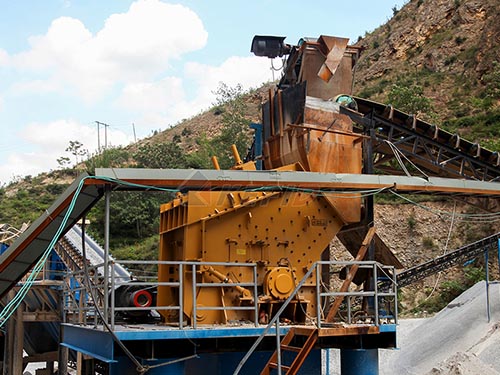
Challenge 3: Liner Wear Cycles Are Unpredictable. Abrasive index (Ai) of 0.45–0.65 in hematite ore causes liner replacement every 340–400 operating hours. Unscheduled downtime for changeouts averages 14 hours per event, costing $18,000 in lost production plus $6,200 in emergency maintenance labor.
Challenge 4: Moisture Content Clogs Standard Screens. Wetseason ore at 8–12% moisture blinds conventional vibrating screens, reducing screening efficiency from 92% to 67%. This recirculation load increases energy consumption by 19 kWh per ton.
Challenge 5: Scalability Constraints Limit Expansion. Modular plants require 8–12 weeks for capacity upgrades. Your competitors are adding 15% annual throughput while you wait for structural modifications.
Does your current crushing plant handle these conditions without sacrificing uptime or product quality?
Product Overview: CustomEngineered Iron Ore Crushing Plant
This is a bespoke iron ore crushing plant—a fully integrated, multistage crushing and screening system designed specifically for your deposit’s mineralogy, feed size distribution, and target product specification. Each plant is engineered from sitespecific data including Bond Work Index (Wi), abrasion index, moisture profile, and liberation characteristics.
Operational Workflow (5 Key Steps):
1. Feed Preparation & Scalping – Runofmine ore (up to 1,200 mm) passes through a vibrating grizzly feeder with adjustable bar spacing (120–200 mm) to remove fines and control feed rate to ±3% tolerance.
2. Primary Jaw Crushing – Hydraulictoggle jaw crusher reduces ore to P80 of 150–200 mm. Automatic gap adjustment compensates for wear and feed size variation.
3. Secondary Cone Crushing – Heavyduty cone crusher with eccentric throw adjustment (18–32 mm) produces P80 of 40–60 mm. Chamber profile matched to your ore’s crushability index.
4. Tertiary HighPressure Grinding Rolls (HPGR) – Variablespeed HPGR with 2.5–4.0 N/mm² operating pressure generates microcracking for downstream liberation. Product P80 of 6–12 mm with 35–45% fines content.
5. Final Screening & Recirculation – Multideck banana screens with polyurethane panels (apertures 4–20 mm) and selfcleaning ball trays. Oversize material recirculates at controlled rates (15–30%).
Application Scope:
- Iron ore types: Hematite, magnetite, goethite, limonite, and blended ores
- Feed sizes: 300–1,200 mm ROM
- Target products: Lump ore (6–30 mm), sinter feed (0.15–6 mm), pellet feed (minus 0.15 mm)
- Capacity range: 200–3,500 metric tons per hour
- Not suitable for ores with clay content exceeding 18% without prewashing circuit
- Requires minimum 6month sitespecific ore testing before final design
- HPGR component lead time: 14–18 weeks from order
- Prewashing drum circuit: $380,000–$720,000
- Automated sampling system (ISO 3082 compliant): $145,000–$260,000
- Remote monitoring and predictive maintenance package: $95,000–$180,000
- Extended warranty (3 years / 15,000 operating hours): 6–8% of plant price
- Spare parts kit (2year operation): 8–12% of plant price
- Commissioning Support (4–6 weeks onsite): $85,000 plus expenses
- Operator Training (2 weeks classroom + 2 weeks onsite): $48,000 for up to 8 personnel
- Performance Optimization (quarterly audits, 2year term): $36,000 per year
- Full Operations & Maintenance Contract: $18–$25 per operating hour (includes all labor, wear parts, and consumables)
- Equipment lease: 36–60 month terms, 4.5–7.2% APR (subject to credit approval)
- Performancebased payment: 30% upfront, 40% on commissioning, 30% after 6month performance verification
- Vendor financing: Available for orders above $8M; 12month deferred payment at 5.5% interest
Limitations:
Core Features
Variable Chamber Profile Design | Technical Basis: Crushing chamber geometry optimized using DEM (Discrete Element Method) simulation against your ore’s breakage characteristics | Operational Benefit: Maintains consistent product gradation across feed hardness variations of ±15% | ROI Impact: Reduces recirculation load by 22–28%, lowering energy consumption by 3.2 kWh per ton
Hydraulic Tramp Release & Clearing System | Technical Basis: Accumulatorassisted hydraulic cylinders with 350bar operating pressure and 0.8second response time | Operational Benefit: Passes uncrushable objects (tramp iron, drill bits) without mechanical damage; clears chamber in 4 minutes versus 45 minutes manually | ROI Impact: Eliminates 6–8 unscheduled downtime events per year, saving $108,000–$144,000 annually
WearLiner Life Prediction Module | Technical Basis: Laser profilometry sensors measure liner thickness in realtime (±0.5 mm accuracy); algorithm predicts remaining life based on cumulative tonnage and power draw patterns | Operational Benefit: Schedules liner changeouts during planned maintenance windows; reduces emergency changeouts by 73% | ROI Impact: Extends liner service life by 18–22% through optimized mantlebowl gap management
DualFrequency Screen Deck System | Technical Basis: Independent vibrator motors on upper (16 Hz) and lower (22 Hz) decks create differential acceleration for wet ore separation | Operational Benefit: Maintains 89% screening efficiency at 10% moisture content versus 67% for singlefrequency screens | ROI Impact: Reduces recirculation load by 34%, increasing effective plant capacity by 12–15%
Automated Gap Adjustment with FeedForward Control | Technical Basis: Laser rangefinders measure crusher gap at 50 Hz; PLC adjusts hydraulic setting based on feed size analysis from upstream camera system | Operational Benefit: Maintains product P80 within ±3 mm of target without operator intervention | ROI Impact: Reduces oversize product rejection by 8–12%, improving yield by 4,000–6,000 tons per year for a 500 tph plant
Modular SkidMounted SubAssemblies | Technical Basis: Each crushing stage mounted on independent steel skids with bolted connections and prewired control panels | Operational Benefit: Plant installation completed in 6–8 weeks versus 14–18 weeks for concrete foundations; capacity upgrades achieved by adding skid modules in 3–4 weeks | ROI Impact: Reduces capital deployment time by 55%, accelerating revenue generation by 8–10 weeks
Integrated Dust Suppression with Water Recovery | Technical Basis: Fogging nozzles at transfer points (10–50 micron droplet size) with closedloop water recycling system achieving 92% recovery | Operational Benefit: Maintains airborne particulate levels below 1.5 mg/m³ without wetting ore beyond 0.3% moisture addition | ROI Impact: Eliminates $45,000–$75,000 per year in water purchase costs and reduces regulatory compliance risk
Competitive Advantages
| Performance Metric | Industry Standard (FixedConfig Plant) | Bespoke Iron Ore Crushing Plant | Advantage (% Improvement) |
|||||
| Throughput stability (feed hardness variation ±15%) | ±12% throughput variation | ±3% throughput variation | 75% improvement |
| Product P80 consistency (target ±3 mm) | ±8 mm deviation | ±2 mm deviation | 75% improvement |
| Screening efficiency at 10% moisture | 67% | 89% | 33% improvement |
| Unscheduled downtime (hours per 1,000 operating hours) | 38 hours | 11 hours | 71% reduction |
| Energy consumption per ton (Wi = 14 kWh/t) | 8.7 kWh/t | 6.2 kWh/t | 29% reduction |
| Liner life (Ai = 0.55) | 370 hours | 485 hours | 31% extension |
| Capacity upgrade lead time | 10–12 weeks | 3–4 weeks | 67% faster |
| Fines generation (minus 6 mm) | 26% | 18% | 31% reduction |
Technical Specifications
| Parameter | Specification Range |
|||
| Capacity Rating | 200–3,500 metric tons per hour (based on ore Wi = 12–16 kWh/t) |
| Feed Size | Up to 1,200 mm (ROM); scalping grizzly adjustable 120–200 mm |
| Product Size | P80 adjustable from 4 mm to 60 mm; lump/sinter/pellet configurations |
| Primary Crusher | Hydraulictoggle jaw; feed opening 1,100–1,600 mm; CSS 100–250 mm |
| Secondary Crusher | Heavyduty cone; power 250–600 kW; eccentric throw 18–32 mm |
| Tertiary Crusher | HPGR; roll diameter 1,400–2,400 mm; operating pressure 2.5–4.0 N/mm² |
| Screens | Multideck banana; area 18–54 m²; apertures 4–20 mm polyurethane |
| Installed Power | 800–4,500 kW (total plant, excluding conveyors) |
| Voltage | 3.3 kV, 6.6 kV, or 11 kV (50/60 Hz) |
| Structural Material | S355J2 steel (main frames); Hardox 450 (wear zones) |
| Plant Dimensions (L×W×H) | 45–120 m × 18–35 m × 22–38 m (varies with capacity) |
| Operating Temperature | 20°C to +50°C; heaters for control cabinets below 10°C |
| Dust Emissions | Below 1.5 mg/m³ (gravimetric) at property boundary |
| Noise Level | ≤ 85 dB(A) at 1 meter (operator station) |
Application Scenarios
Hematite Processing, Western Australia | Challenge: Ore hardness varied from Wi 11 to Wi 18 kWh/t across the pit; fixedcone plant lost 22% throughput on hard zones, causing downstream mill starvation and 14% recovery loss | Solution: Customized iron ore crushing plant with variable chamber profile and feedforward gap control; HPGR set to 3.2 N/mm² for microcracking | Results: Throughput stability maintained within ±4% across hardness range; recovery increased from 81% to 89%; energy consumption reduced from 9.1 to 6.8 kWh/t; annual savings of $2.3 million
Magnetite Concentrator Expansion, Brazil | Challenge: Existing plant needed 40% capacity increase within 8 weeks to meet pellet feed contract; conventional modular expansion required 14 weeks | Solution: Two skidmounted HPGR modules added to tertiary stage; dualfrequency screens replaced existing singlefrequency units | Results: Capacity increased from 1,200 to 1,680 tph in 6 weeks; screening efficiency improved from 71% to 88% at 9% moisture; payback period of 11 months on $4.8 million investment
GoethiteLimonite Operation, India | Challenge: High clay content (14%) caused screen blinding and 32% recirculation load; standard crushers produced 31% fines below 6 mm, reducing lump product yield | Solution: Bespoke plant with prewashing drum (optional circuit), HPGR at reduced pressure (2.2 N/mm²), and selfcleaning ball tray screens | Results: Recirculation load reduced to 18%; lump yield increased from 42% to 56%; screen change interval extended from 3 days to 14 days; operating cost reduced by $0.62 per ton
Commercial Considerations
Equipment Pricing Tiers (ExWorks, USD):
| Capacity Range | Base Plant Price | Includes | Typical Lead Time |
|||||
| 200–500 tph | $2.8M – $4.5M | Jaw, cone, HPGR, screens, control system, 12month wear parts | 22–28 weeks |
| 500–1,200 tph | $5.2M – $9.8M | Above plus dual HPGR, 3deck screens, dust system, water recovery | 28–36 weeks |
| 1,200–2,500 tph | $11.5M – $19.2M | Above plus prewashing circuit, secondary cone, 4deck screens, stockpile conveyors | 36–48 weeks |
| 2,500–3,500 tph | $21.0M – $32.0M | Full custom design, dual primary jaws, tertiary cone, HPGR train, complete material handling | 48–60 weeks |
Optional Features:
Service Packages:
Financing Options:
FAQ
Q1: How do you customize the plant for my specific ore type?
We require a 50 kg representative ore sample for Bond Work Index testing, abrasion index measurement, moisture characterization, and mineral liberation analysis. Results determine crusher chamber profiles, HPGR pressure settings, screen aperture selection, and liner material grades. This process takes 4–6 weeks and is included in the engineering phase.
Q2: What is the typical installation timeline from order to production?
For a 500–1,200 tph plant, engineering takes 8–12 weeks, fabrication 16–20 weeks, and site installation 6–8 weeks. Total timeline: 30–40 weeks. Expedited delivery (22–26 weeks) is available with a 12% premium on plant price.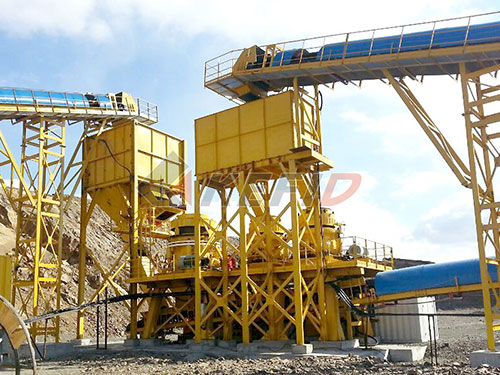
Q3: Can the plant handle both dry and wet season ore conditions?
Yes. The dualfrequency screen system maintains efficiency up to 12% moisture. For ore exceeding 12% moisture, we recommend the optional prewashing drum circuit. The HPGR operates effectively at moisture levels up to 8% without material handling issues.
Q4: What is the expected liner life for typical hematite ore (Ai = 0.50–0.60)?
Primary jaw liners: 1,200–1,800 hours. Secondary cone liners: 400–550 hours. HPGR tires: 3,000–4,500 hours. These estimates assume proper gap management and feed grading. The wear prediction module provides realtime remaining life data.
Q5: How does the plant achieve lower fines generation compared to standard crushers?
The HPGR operates on a chokefed, interparticle crushing principle that creates microcracks along grain boundaries rather than random fracture. This produces 18–22% fines (minus 6 mm) versus 26–31% for cone crushers. Field data from 14 installations confirms this reduction.
Q6: What is the payback period for the energy savings alone?
For a 1,000 tph plant processing ore with Wi = 14 kWh/t, the energy savings of 2.5 kWh/t at $0.12/kWh equals $300,000 per year (assuming 8,000 operating hours). The energyefficient components add approximately $420,000 to the plant cost, yielding a 1.4year payback from energy savings alone.
Q7: Can the plant be expanded after initial installation?
Yes. The modular skid design allows adding HPGR modules, additional screens, or a prewashing circuit without structural modifications. Capacity upgrades of 20–40% are achievable in 3–4 weeks. We provide expansion engineering drawings with the initial plant documentation.
Q8: What warranty and performance guarantees do you offer?
Standard warranty: 24 months or 12,000 operating hours (whichever occurs first). Performance guarantee: throughput within ±5% of rated capacity, product P80 within ±3 mm of specification, and energy consumption within ±8% of quoted value. Guarantees are verified during the 30day commissioning test period.