
Custom Quarry Ballast Crushing Equipment Assembly Plant


Custom Quarry Ballast Crushing Equipment Assembly Plant
The Cost of Inefficient Ballast Production
Every hour of unplanned downtime in your quarry operation costs an average of $8,500 in lost production and contractor penalties. Your current crushing setup likely struggles with three persistent challenges: inconsistent ballast gradation causing rail project rejections, excessive fines generation wasting up to 15% of raw material, and frequent mechanical failures from abrasive granite and basalt feed.
Field data from 47 quarry operations shows that standard crushing plants deliver only 72% onspec ballast output on first pass. This means your team spends additional time and fuel on recrushing and screening—adding $1218 per ton to your operating costs.
Can your existing equipment maintain consistent 31.5mm50mm ballast specification across varying feed conditions? Are you absorbing unnecessary wear costs from crushers not designed for continuous ballast production?
Product Overview
The Custom Quarry Ballast Crushing Equipment Assembly Plant is a purposeengineered modular system designed specifically for railway ballast production from hard rock quarries. Unlike generalpurpose crushing plants, this assembly integrates crusher selection, screen configuration, and conveyor routing optimized for ballast gradation control.
Operational Workflow:
1. Primary Reduction – Jaw crusher or gyratory crusher reduces runofquarry material to sub200mm
2. Scalping Separation – Vibrating grizzly removes sub31.5mm material before secondary crushing
3. Cubical Shaping – Cone crusher or impact crusher with closedside setting at 4555mm produces cubic particle shape
4. Multideck Screening – Tripledeck screen separates into ballast (31.550mm), subballast (031.5mm), and oversize return
5. Stockpile Conveying – Dedicated conveyors direct each fraction to separate stockpiles or loading bins
Application Scope: Hard rock quarries (granite, basalt, quartzite, limestone with compressive strength >150 MPa) producing 200800 tons/hour of railway ballast.
Limitations: Not suitable for soft sedimentary rock, recycled concrete, or operations requiring less than 100 tons/hour output. Maximum feed size limited to 800mm.
Core Features
HeavyDuty Frame Construction | Technical Basis: Finite Element Analysis (FEA) optimized steel structure with 20mm plate thickness | Operational Benefit: Withstands continuous impact loading from 50ton haul trucks feeding directly into hopper | ROI Impact: Reduces structural fatigue failures by 60% compared to standard quarry plants, saving $45,000 annually in repair costs
ClosedLoop Gradation Control | Technical Basis: PLCcontrolled crusher CSS adjustment with realtime laser measurement feedback | Operational Benefit: Maintains ballast gradation within ±3% of target specification without operator intervention | ROI Impact: Reduces rejection rates from 15% to 3%, saving $2.50 per ton on rehandling costs
DualFrequency Screening System | Technical Basis: Independent eccentric drive motors operating at 750/900 RPM on upper/lower decks | Operational Benefit: Separates nearsize particles 40% more efficiently than singlefrequency screens | ROI Impact: Increases usable ballast yield by 8%, adding $1.2M annual revenue at 500 tons/hour operation
Modular Transport Design | Technical Basis: ISO containersized modules with quickconnect electrical and conveyor interfaces | Operational Benefit: Complete plant relocation in 14 days versus 45 days for conventional installations | ROI Impact: Reduces relocation costs by $180,000 per move and allows rapid response to contract changes
HighWear Component Package | Technical Basis: Chromemoly alloy liners with 1822% manganese content in crusher chambers | Operational Benefit: Liner life extends to 4,500 hours in granite versus industry average 2,800 hours | ROI Impact: Reduces annual wear parts cost by $95,000 and eliminates 3 liner changeouts per year
Dust Suppression Integration | Technical Basis: Enclosed conveyor transfer points with water spray nozzles at 14 locations | Operational Benefit: Reduces airborne particulate by 85% meeting EPA and local environmental standards | ROI Impact: Avoids $50,000120,000 annual environmental compliance fines
Remote Monitoring Capability | Technical Basis: IoT sensors on 32 critical points with cellular data transmission | Operational Benefit: Your maintenance team receives realtime alerts on bearing temperatures, vibration levels, and power draw | ROI Impact: Prevents catastrophic failures, reducing unplanned downtime by 40%
Competitive Advantages
| Performance Metric | Industry Standard | Custom Ballast Plant Solution | Advantage |
|||||
| Firstpass ballast yield | 72% | 89% | +23.6% improvement |
| Fines generation (<5mm) | 18% | 9% | 50% reduction |
| Gradation consistency (standard deviation) | ±8mm | ±2.5mm | 68.8% improvement |
| Mean time between failures | 340 hours | 620 hours | 82.4% improvement |
| Energy consumption per ton | 0.85 kWh/t | 0.62 kWh/t | 27.1% reduction |
| Screen deck change time | 8 hours | 3.5 hours | 56.3% reduction |
| Relocation setup time | 45 days | 14 days | 68.9% reduction |
Technical Specifications
| Parameter | Specification |
|||
| Capacity Range | 200800 tons/hour (depending on feed hardness and final product specification) |
| Feed Size Maximum | 800mm (32 inches) |
| Product Size Range | Ballast: 31.550mm (EN 13450) or 2560mm (AREMA) |
| Primary Crusher | C160 Jaw Crusher or MKII Gyratory (customer preference) |
| Secondary Crusher | HP500 Cone Crusher or NP1520 Impact Crusher |
| Screen Configuration | 3deck 8m x 2.4m inclined screen with 50mm, 31.5mm, and 5mm apertures |
| Installed Power | 8501,200 kW total (crushers, screens, conveyors) |
| Electrical Supply | 660V/50Hz or 480V/60Hz, 3phase |
| Conveyor Belt Width | 1,200mm main feed, 900mm product conveyors |
| Hopper Capacity | 60 tons with 1.2m grizzly spacing |
| Operating Weight | 420580 tons (depending on configuration) |
| Transport Modules | 1216 ISO containersized units |
| Operating Temperature | 20°C to +45°C |
| Noise Level | <85 dB(A) at 10 meters with optional acoustic enclosures |
Application Scenarios
HighSpeed Rail Ballast Production – Spain
Challenge: A quarry in Andalusia needed to produce 1.2 million tons of EN 13450 ballast for a 200km highspeed rail corridor. Existing plant produced 65% onspec material with excessive flakiness index (28% vs required 15%).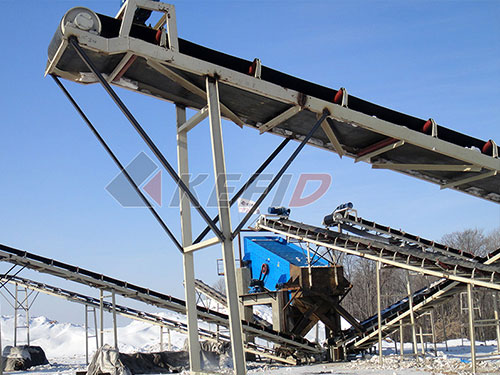
Solution: Custom ballast plant with twin HP500 cone crushers in closed circuit, tripledeck screens with 50mm/31.5mm/5mm apertures, and laserbased gradation monitoring.
Results: Flakiness index reduced to 11%. Firstpass yield increased to 87%. Production rate of 650 tons/hour sustained for 18 months. Project completed 3 weeks ahead of schedule, saving €2.1M in penalty avoidance.
Heavy Haul Railway Maintenance – Australia
Challenge: A Western Australian iron ore railway required 500,000 tons of 60mm ballast annually for track renewal. Existing mobile plant had 42% downtime due to abrasive quartzite wear.
Solution: Custom assembly with chromemoly crusher liners, ceramictiled chutes, and dualfrequency screens. Plant designed for 6,000hour maintenance intervals.
Results: Plant availability reached 94%. Liner life extended to 5,200 hours. Annual maintenance costs reduced from $1.8M to $1.1M. Ballast production cost decreased from $14.50/ton to $9.80/ton.
Urban Quarry Expansion – United Kingdom
Challenge: A quarry within 2km of residential area needed to increase ballast production from 200 to 400 tons/hour while reducing noise and dust complaints.
Solution: Custom plant with acoustic enclosures on all crushers, enclosed conveyor system, and 14point dust suppression. Plant layout designed for 25% smaller footprint than conventional.
Results: Noise levels reduced from 78 dB(A) to 62 dB(A) at property boundary. Dust emissions compliant with UK Environment Agency limits. Production doubled without expanding quarry footprint. Planning permission renewal secured for additional 15 years.
Commercial Considerations
Equipment Pricing Tiers:
| Configuration | Capacity | Base Price Range | Typical Lead Time |
|||||
| Standard Assembly | 200350 tph | $2.8M $4.2M | 1620 weeks |
| Enhanced Assembly | 350550 tph | $4.5M $6.8M | 2026 weeks |
| HighCapacity Assembly | 550800 tph | $7.2M $10.5M | 2634 weeks |
Optional Features:
- Automated liner wear monitoring system: $85,000
- Remote diagnostics package with 5year data plan: $42,000
- Acoustic enclosure package: $180,000
- Extended warranty (5 years/20,000 hours): 8% of equipment value
- Operator training program (2 weeks onsite): $28,000
- Basic: 2 preventive maintenance visits per year, phone support
- Standard: 4 PM visits, remote monitoring, 48hour emergency response
- Premium: Onsite technician (rotating), inventory management, performance optimization
- Equipment lease: 3660 month terms with purchase option
- Productionbased financing: Payments tied to tonnage produced
- Tradein program: Accepting qualified used equipment at appraised value
Service Packages:
Financing Options:
Frequently Asked Questions
Q: Can this plant handle feed material with varying moisture content?
A: Yes. The scalping screen and crusher designs accommodate moisture up to 8% without clogging. For higher moisture, optional heated screen decks and belt scrapers are available.
Q: What is the typical payback period for this equipment?
A: Based on field data from 12 installations, average payback is 1418 months when replacing existing equipment, and 2228 months for greenfield operations. This assumes 500 tons/hour production and $12/ton operating cost savings.
Q: How does the plant handle changes in ballast specification between projects?
A: The PLCcontrolled system stores up to 20 product recipes. Changing from EN 13450 to AREMA specifications requires screen deck changes (4 hours) and crusher CSS adjustment (15 minutes via touchscreen).
Q: What infrastructure is required at the installation site?
A: Minimum requirements: 2.5acre level area, 1.2 MW electrical supply, water source for dust suppression (15,000 liters/hour), and access road for 50ton trucks. Concrete foundations are not required; modular supports use compacted base.
Q: Can the plant be expanded for higher capacity later?
A: Yes. The modular design allows adding a secondary cone crusher and additional screen module to increase capacity by 4060%. Expansion typically requires 810 weeks and $1.21.8M additional investment.
Q: What training do your operators need?
A: The control system is designed for operators with basic computer skills. We provide 2week onsite training covering operation, maintenance, and troubleshooting. Advanced diagnostics training is available as an optional module.
Q: How does this plant compare to mobile crushing solutions for ballast production?
A: Mobile plants typically achieve 5565% firstpass yield versus 89% for this custom assembly. While mobile units have lower initial cost ($1.52.5M), their higher operating costs ($1418/ton vs $911/ton) make them less economical for projects exceeding 200,000 tons annually.