
Crushing And Screening Equipment Dealers Factory Price


Targeted Solutions for Crushing and Screening Equipment: Maximizing Uptime and ROI
Are you managing escalating operational costs due to frequent equipment downtime? Confronted with inconsistent final product gradation that leads to rejected loads and revenue loss? Struggling with high maintenance hours, excessive energy consumption per ton processed, or the logistical complexity of managing multiple material stockpiles? For plant managers and engineering contractors, these aren't just inconveniences—they directly impact your project timelines and bottom line. How do you achieve higher throughput without proportionally increasing your operating expenses? Can your crushing and screening circuit adapt efficiently to varying feed materials? Is your current equipment costing you more in repairs and downtime than its capital value justifies?
Product Overview: HighEfficiency Stationary & Mobile Crushing and Screening Plants
Our crushing and screening equipment encompasses a range of stationary, modular, and trackmounted mobile solutions designed for the primary, secondary, tertiary, and quaternary reduction of aggregates, ore, and demolition/recycled materials. The operational workflow is engineered for linear efficiency: 1. Primary Feeding & Crushing: Scalping of fines and primary size reduction via jaw or gyratory crushers. 2. Material Conveying & Transfer: Highcapacity, regulated transfer to secondary circuits. 3. Secondary/Tertiary Crushing: Cone or impact crushers refine material size. 4. Precision Screening: Multideck vibrating screens accurately separate material into specified grades. 5. Stockpiling/Recirculation: Finished product conveyance and closedcircuit return of oversize material.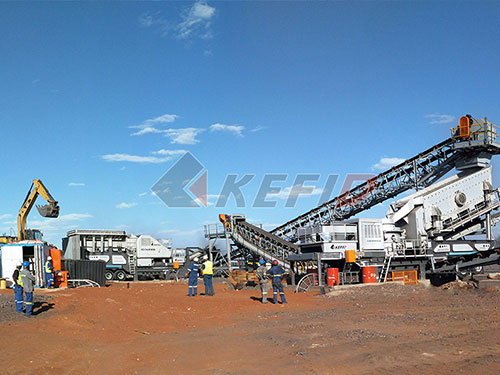
Application scope includes quarrying, mining, construction aggregates, and C&D recycling. Key limitations are defined by feed size hardness (abrasion index) and required final product specifications; our engineering team conducts presale analyses to ensure equipment matching.
Core Features: Engineered for Performance
Advanced Chamber Geometry | Technical Basis: Optimized kinematics & cavity design | Operational Benefit: Higher reduction ratios per crushing stage, reduced recirculating load | ROI Impact: Lower energy cost per ton produced, increased overall circuit capacity by 1525%
Hybrid Energy Drive Systems | Technical Basis: Direct dieselelectric crusher/screen drives with onboard genset | Operational Benefit: Significant fuel savings (up to 40% documented) versus traditional hydraulic drives; peak power on demand | ROI Impact: Direct reduction in operating costs, especially in fuelprice volatile markets
Modular Component Design | Technical Basis: Standardized, interchangeable wear parts & modules | Operational Benefit: Reduced spare parts inventory complexity; faster replacement times during maintenance | ROI Impact: Lower inventory carrying costs and reduced mean time to repair (MTTR), boosting asset availability

Centralized Greasing & Automation | Technical Basis: Automated lubrication systems with programmable intervals & monitoring | Operational Benefit: Ensures optimal bearing health under highload conditions; reduces manual labor requirements | ROI Impact: Extends component service life by up to 30%, preventing costly unplanned failures
Adaptive Screen Media Technology | Technical Basis: Quickchange tensioning systems with polyurethane & rubber compound options | Operational Benefit: Minimizes screen blinding; allows rapid media type change for different materials | ROI Impact: Maintains consistent product quality and screening efficiency, reducing waste from offspec material
Telematics & Remote Monitoring | Technical Basis: Integrated IoT sensors for tracking production rates, CSS settings, power draw, and location data | Operational Benefit: Enables realtime performance optimization and predictive maintenance alerts from any location | ROI Impact: Datadriven decision making prevents minor issues from escalating into major downtime events.
Competitive Advantages
| Performance Metric | Industry Standard Benchmark | Our Crushing & Screening Solution Documented Improvement |
| : | : | : |
| Tons per Hour per kW/h (Energy Efficiency) 95105 tph/kWh 115130 tph/kWh +18% to +24% |
| Mean Time Between Failures (Critical Components) ~1,2001,500 hours ~1,8002,200 hours +40% improvement |
| Screen Cloth/Dexter Panel Changeover Time 46 hours 1.52.5 hours ~60% time reduction |
| Overall Equipment Effectiveness (OEE) in Quarry Applications ~76% ~84% +8 percentage points |
Technical Specifications
Capacity Range: Stationary plants from 200 to over 1,500 tph; Mobile tracked units from 150 to 450 tph.
Power Requirements: Configurable for 400V/50Hz or 480V/60Hz mains power. Mobile units feature Tier 4 Final/EU Stage V compliant diesel generators from 350 kVA to 600 kVA.
Material Specifications: Crusher jaws/mantles/liners manufactured from multialloy manganese steel (18%22% Mn). Chassis constructed from hightensile strength steel (S355J2/N).
Physical Dimensions (Mobile Plant Example): Working length approx. 20m; Working height approx. 5m; Transport weight between 4565 tonnes depending on configuration.
Environmental Operating Range: Designed for ambient temperatures from 25°C to +45°C. Dust suppression systems standard for compliance in regulated environments.
Application Scenarios
Granite Quarry Expansion Challenge:
A large aggregate producer needed to increase plant output by 35% but was constrained by existing footprint and rising energy costs.
Solution:
Implementation of a hybridenergy tertiary crushing and screening closed circuit plant with advanced chamber geometry crushers.
Results:
Throughput increased by 38%. Energy consumption per ton decreased by 22%. The compact layout was accommodated within the existing site plan.
Urban C&D Recycling Operation Challenge:
A recycling contractor faced high wear costs from contaminated demolition concrete/ashphalt feedstocks and frequent screen blinding causing downtime.
Solution:
Deployment of a tracked impact crusher with modular wear parts and adaptive screen media technology featuring quickchange polyurethane panels.
Results:
Wear part changeout time reduced by half. Screen media life increased by approximately threefold due to reduced abrasion from wires/contaminants.
Commercial Considerations
Equipment is offered across three primary tiers:
Standard Duty Configuration: For consistent feed materials like clean limestone/aggregate. Focus on core reliability.
HeavyDuty Configuration: Enhanced components for abrasive materials (e.g., granite, slag). Includes upgraded wear liners and bearings.
Modular/FutureReady Configuration: Designed for easy future capacity upgrades or process flow modifications.
Optional features include advanced dust suppression cannons,magnetic separators,and extendedlength stockpile conveyors.Service packages range from basic warranty support to comprehensive fullservice maintenance contracts covering all parts,labor,and scheduled servicing.Financing options include capital lease agreements,tailored rentaltoown programs,and projectbased financing through accredited partners.
Frequently Asked Questions
Q1: Can your mobile crushing plants integrate with our existing stationary conveying infrastructure?
A1 Yes.Field integration is common.We engineer transfer points with custom chutework,belt widths,and drive speeds to ensure compatibility with your current stockpiling systems.
Q2 What is the typical lead time on critical wear parts like crusher mantles or jaw dies?
A2 We maintain a global network of strategically located parts depots.For standard profiles,target lead time is within five business days.Emergency air freight options are available.
Q3 How does the remote monitoring system work,and who has access to the data?
A3 The telematics system transmits encrypted operational data via cellular/satellite networks.Access is provided through a secure web portal exclusivelyto youand our authorized service teamfor support purposes.Data ownership remains entirelywith the customer.
Q4 Are there financing structures that account for seasonal fluctuations in our production volume?
A4 Yes.We offer flexible payment plans that can align with seasonal cash flow cycles.This can include stepup payment structures during peak production months after commissioning.
Q5 What level of operator training is provided upon installation?
A5 We provide comprehensive onsite training over twotothree daysfor both operatorsand maintenance personnel.This covers daily checks,safe operation,basic troubleshooting,and proper proceduresfor wear part changes.Training manualsand digital resources are supplied