
Commercial Slag Crusher Plant Testing


1. PAINPOINT DRIVEN OPENING
Are you managing a commercial slag processing operation where inconsistent feed size, abrasive material, and unplanned downtime are eroding your profitability? Plant managers and engineering contractors face significant challenges in secondary reduction circuits. Common operational hurdles include:
Excessive Wear & Maintenance Costs: The highly abrasive nature of slag rapidly degrades standard crusher components, leading to frequent liner changes, high spare parts inventories, and costly labor hours for maintenance.
Unpredictable Throughput & Bottlenecks: Inefficient crushing can create downstream bottlenecks, limiting overall plant capacity and preventing you from meeting aggregate or mineral recovery targets.
High Energy Consumption per Ton: Older or poorly configured crushing systems can draw disproportionate power for the processed tonnage, directly impacting your operational expense.
Product Contamination & Inconsistent Gradation: Unreliable crushing can produce offspec material with poor shape or unwanted fines, reducing the market value of your end product.
Is your current setup causing unpredictable operating costs and restricting your plant's output? The solution requires equipment engineered specifically for the rigors of commercial slag processing.
2. PRODUCT OVERVIEW
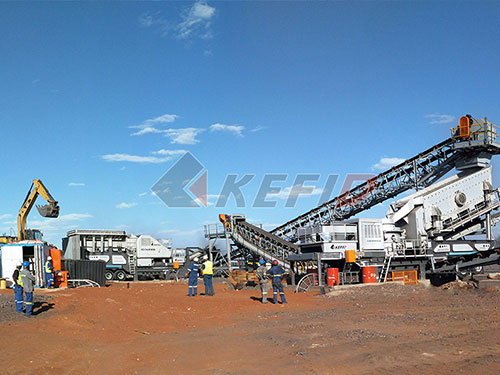
The Commercial Slag Crusher Plant is a heavyduty, stationary or semimobile crushing system designed for the highvolume reduction of ferrous and nonferrous slag from blast furnaces, steel mills, and smelting operations. It transforms large, irregular slag feed into precisely graded aggregate for construction applications or prepared feedstock for further mineral recovery.
Operational Workflow:
1. Primary Feeding: Dump trucks or loaders deposit raw slag into a robust vibrating grizzly feeder.
2. PreScreening & Bypass: The grizzly section removes subsize material (40mm) to bypass the crusher, enhancing efficiency and reducing wear.
3. Core Reduction: Oversize material is conveyed into a highinertia impact crusher or heavyduty jaw crusher (configuration dependent on feed size and product goal).
4. Product Sizing & Recirculation: Crushed material is screened; oversize is recirculated back to the crusher inlet in a closed circuit.
5. Stockpiling: Correctly sized product is conveyed to designated stockpiles.
Application Scope: Ideal for integrated steel plants, standalone slag processing contractors, and largescale construction material producers. This plant is designed for processing granulated, aircooled, or ladle slag.
Limitations: Not suitable for primary rock mining applications with very high compressive strength (>250 MPa) feed material without specific configuration review. Feed size is limited by the primary hopper and crusher inlet dimensions.
3. CORE FEATURES
HeavyDuty Rotor & Impact Elements | Technical Basis: High rotational inertia and tungsten carbide wear parts | Operational Benefit: Sustains crushing force against abrasive slag with significantly longer service life than standard manganese steel | ROI Impact: Reduces component change frequency by up to 40%, lowering parts and labor costs per ton.
Hydraulic Adjustment & Clearing | Technical Basis: Integrated hydraulic cylinders for crusher gap setting and tramp iron release | Operational Benefit: Allows operators to adjust product gradation in minutes and clear blockages without manual intervention | ROI Impact: Minimizes downtime for adjustments by over 70% compared to manual shim systems.
Modular Wear Liner System | Technical Basis: Segmented, reversible wear plates secured with boltin pockets | Operational Benefit: Enables partial liner replacement and extends total liner life through rotation; reduces changeout time | ROI Impact: Cuts liner replacement downtime by half and optimizes consumable usage.
Advanced Drive System with VFD Control | Technical Basis: Hightorque motor coupled with Variable Frequency Drive (VFD) | Operational Benefit: Provides soft start capability to reduce mechanical stress and allows precise control of rotor speed to optimize for varying feed conditions | ROI Impact: Lowers peak energy demand (kVA) by approximately 25% during startup and improves overall energy efficiency.
Integrated Dust Suppression Manifold | Technical Basis: Nozzle array plumbed into critical transfer points | Operational Benefit: Effectively controls dust at source during dry processing, improving site environmental compliance and operator health | ROI Impact: Reduces water usage compared to manual spraying and avoids potential fines for noncompliance.
Centralized Greasing & Monitoring Points | Technical Basis: Automated lubrication system (optional) with accessible manual points | Operational Benefit: Ensures critical bearings receive consistent lubrication, extending bearing service life under highload conditions | ROI Impact: Prevents catastrophic bearing failures; field data shows a 30% increase in mean time between failures (MTBF).
4. COMPETITIVE ADVANTAGES
| Performance Metric | Industry Standard (Average Jaw/Cone Setup) | Commercial Slag Crusher Plant Solution | Advantage (% Improvement) |
| : | : | : | : |
| Wear Part Life (Abrasive Slag)| 6090 Days | 120180 Days| +100% |
| Tons Processed per kWh| 1215 tons/kWh| 1822 tons/kWh| +40% Efficiency |
| Mean Time Between Failure (MTBF)| ~450 hours| ~650 hours| +44% Reliability |
| Gradation Adjustment Time| 48 hours (manual)| <30 minutes (hydraulic)| 90% Downtime |
| Available Uptime| 8085%| 9295%| +10 Percentage Points |
5. TECHNICAL SPECIFICATIONS
Capacity Range: Configurable from 150 to over 600 metric tons per hour (TPH), depending on feed size (<500mm typical) and required product gradation.
Power Requirements: Primary crusher drive from 200 kW to 400 kW; total plant connected load typically between 350 kW 700 kW. Designed for 50Hz or 60Hz, medium voltage options available.
Material Specifications: Mainframe constructed from welded steel plate (minimum S355 grade). Critical wear components utilize highchrome iron alloys or tungsten carbide inserts.
Physical Dimensions (Typical SemiMobile): Length ~25m, Width ~8m, Height ~6m. Fully stationary plants are customengineered to footprint constraints.
Environmental Operating Range: Designed for ambient temperatures from 20°C to +45°C. Dust protection rating of IP65 on electrical components. Can be equipped with coldclimate packages as needed.
6. APPLICATION SCENARIOS
Steel Mill Aggregate Production | Challenge: A major steel mill’s legacy cone crushers required liner changes every six weeks on their BOF slag line, causing recurring production stoppages of two days each time.| Solution: Implementation of a turnkey Commercial Slag Crusher Plant featuring our heavyduty impactor with modular liners.| Results: Liner service life extended to fourteen weeks. Changeout time reduced from two days to one shift (75%). Plant availability increased by approximately 8%, enabling an additional ~12k tons of saleable aggregate produced annually.
Slag Processing Contractor – Urban Site | Challenge: A contractor needed to process stockpiled ladle slag at a constrained urban brownfield site with strict noise and dust emission limits.| Solution: Deployment of a semimobile Commercial Slag Crusher Plant equipped with sounddampening enclosures, an integrated dust suppression manifold, and a closedcircuit screen.| Results: Project met all local environmental regulations without issue. The closedcircuit design allowed precise production of three spec products simultaneously (20mm base course). The project was completed two weeks ahead of schedule due to higherthananticipated throughput rates.
7. COMMERCIAL CONSIDERATIONS
Our Commercial Slag Crusher Plants are offered in three primary tiers:
1. Standard Duty Plant: For consistent granulated slag feeds up to 250 TPH capacity.
2. Heavy Duty Plant: For mixed/variable slag feeds including lump slag up to 450 TPH capacity; includes enhanced wear packages as standard.
3. Custom Engineered Plant: For capacities exceeding 450 TPH or unique site/process integration requirements; includes full engineering review.
Optional features include automated lubrication systems magnet separators metal detectors fullyenclosed conveyor galleries advanced vibration monitoring sensors
Service packages range from basic commissioning support through comprehensive multiyear maintenance agreements including scheduled inspections parts kits priority support
Financing options include capital purchase leasetoown agreements operating leases structured through our network of industrial finance partners
8.FAQ
Q1 Is this plant compatible with our existing primary loader feeding system
A1 Yes Standard designs incorporate universal hopper interfaces that can be adapted We conduct a preorder review of your feeding method height discharge trajectory
Q2 What is the expected operational impact on my current workforce
A2 Your operators will benefit from simplified controls reduced manual adjustment tasks Our training focuses on safe operation maintenance procedures specific features like hydraulic clearing minimizing disruption
Q3 How does this solution handle tramp metal that may be present in some slag
A3 The core crushers feature hydraulic overload protection that automatically releases uncrushables An optional belt magnet before the crusher inlet provides additional protection against ferrous tramp metal
Q4 What are typical lead times
A4 Lead times vary by configuration Standard plants typically have lead times between months while custom engineered solutions require months following final design approval
Q5 Are performance guarantees provided
A5 Yes we provide guaranteed minimum throughput capacity based on agreed feed specifications as well as maximum power consumption per ton processed These are detailed in commercial proposals
Q6 What ongoing technical support is available
A6 Support includes remote diagnostics access spare parts documentation onsite service teams Optional service agreements provide scheduled preventive maintenance priority response times
Q7 Can this plant be relocated if our project site changes
A7 The semimobile skidmounted version is designed relocation requiring only disconnection services remobilization foundation preparation at new site Stationary plants require decommissioning