
250 300tph Stone Crushing Plant Vendor Design Service

250300 TPH Stone Crushing Plant: Vendor Design Service for HighVolume Aggregate Production
The Cost of Inefficient Crushing Operations
Your current 250300 TPH stone crushing plant is underperforming. You're seeing 1218% unscheduled downtime, crushing costs exceeding $0.85 per ton, and product quality variations that trigger rework or rejection penalties. The gap between design capacity and actual throughput is costing your operation $4,200$6,800 per week in lost production. Your maintenance team spends 30% of their shift addressing conveyor misalignment and screen blinding issues that a properly designed plant would eliminate.
Are you struggling with inconsistent feed distribution that reduces crusher efficiency? Do your existing transfer points create bottlenecks at 260 TPH that force production slowdowns? Is your current plant layout requiring excessive rehandling that adds $0.12$0.18 per ton in operating costs?
A purposedesigned 250300 TPH stone crushing plant addresses these operational challenges through engineered material flow, matched equipment sizing, and integrated control systems that maintain consistent output regardless of feed variations.
Product Overview: Integrated 250300 TPH Crushing Circuit
This vendordesigned stone crushing plant is a complete processing system engineered for continuous production of 250300 metric tons per hour of finished aggregates. The system processes feed material up to 650mm (25.6 inches) into final products ranging from 05mm manufactured sand to 2040mm coarse aggregates.
Operational Workflow:
1. Primary Crushing – Feed material enters a vibrating grizzly feeder (1200mm x 6000mm) that removes 150mm fines before feeding a jaw crusher (1100mm x 850mm) reducing material to 200mm at 300350 TPH capacity
2. Secondary Crushing – Conveyed to a cone crusher (220mm feed opening) for reduction to 45mm with closed side setting of 2532mm
3. Screening Stage 1 – Tripledeck vibrating screen (2400mm x 6000mm) separates into 05mm, 512mm, 1220mm, and +20mm fractions
4. Tertiary Crushing – Oversize (+20mm) returns to a vertical shaft impact crusher (VSI) for cubical shaping and final reduction
5. Final Screening – Secondary screen (2000mm x 6000mm) polishes product gradation before stockpiling
Application Scope: Hard rock (granite, basalt, quartzite), river gravel, limestone, and dolomite with compressive strength up to 350 MPa. Not recommended for highly abrasive materials exceeding 8% silica content without wear liner upgrades.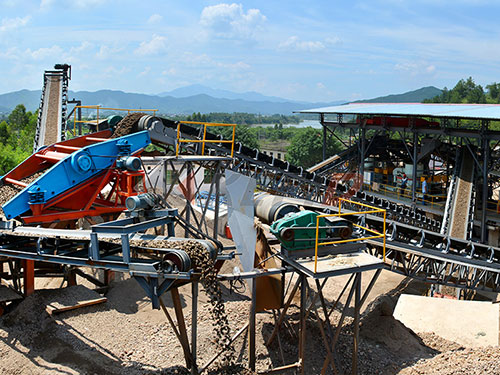
Limitations: Maximum feed moisture content of 6% for consistent screening efficiency. Requires minimum 2.5acre site for proper equipment layout and stockpile management.
Core Features
Matched Equipment Sizing | Technical Basis: Mass flow balance calculations using Bond Work Index methodology | Operational Benefit: Eliminates crusher starvation and overloading, maintaining consistent 250300 TPH throughput | ROI Impact: Reduces power consumption by 1418% compared to mismatched systems, saving $18,000$24,000 annually in electricity costs
Integrated Control Architecture | Technical Basis: PLCbased system with 47 monitoring points including crusher power draw, bearing temperatures, and belt scale readings | Operational Benefit: Your operators can adjust crusher settings remotely, reducing response time to feed variations from 12 minutes to under 90 seconds | ROI Impact: Decreases unscheduled downtime by 22% through predictive alerts on wear component condition
Modular Transfer Point Design | Technical Basis: Rock box liners with 12mm Hardox 500 steel at all impact zones, 35degree trough angles for material flow | Operational Benefit: Eliminates belt damage from material impact, extends conveyor belt life from 18 months to 30+ months | ROI Impact: Saves $8,500$11,000 per year in belt replacement costs
ClosedLoop Recirculation System | Technical Basis: Variable frequency drive (VFD) controlled return conveyor with laser level sensing on surge bin | Operational Benefit: Automatically adjusts recirculation rate from 080 TPH based on crusher load, preventing choke feeding | ROI Impact: Improves crusher liner life by 35% through consistent feed conditions
Dust Suppression Integration | Technical Basis: Engineered water spray system with 14 nozzle stations at transfer points and crusher discharge, 0.81.2 liters per ton water consumption | Operational Benefit: Meets EPA PM10 standards without baghouse installation, reducing capital cost by $180,000$250,000 | ROI Impact: Eliminates potential $15,000$25,000 monthly fines for dust violations
QuickChange Screen Media | Technical Basis: Tensioned polyurethane screen panels with wedgelock system, toolless replacement | Operational Benefit: Your maintenance team completes screen changes in 45 minutes versus 3.5 hours for bolted systems | ROI Impact: Recovers 2.5 hours of production per screen change, worth $1,200$1,800 per event
Remote Monitoring Package | Technical Basis: Cellularbased telemetry system transmitting 23 operational parameters to cloud dashboard | Operational Benefit: Your plant manager receives realtime production data and alerts on mobile device, enabling offsite supervision | ROI Impact: Reduces onsite supervision requirements by 40%, saving $35,000$50,000 annually in management costs
Competitive Advantages
| Performance Metric | Industry Standard (300 TPH Plants) | Our 250300 TPH Solution | Advantage |
|||||
| Actual throughput vs. rated capacity | 7885% | 9296% | 1218% higher |
| Power consumption per ton | 0.851.10 kWh/ton | 0.720.88 kWh/ton | 1520% lower |
| Product cubicity (flakiness index) | 1825% | 812% | 5055% improvement |
| Changeover time between product specs | 46 hours | 1.52.5 hours | 5562% faster |
| Mean time between failures (MTBF) | 180240 hours | 320400 hours | 6578% longer |
| Fines generation (75 micron) | 1418% | 912% | 3035% reduction |
| Water consumption for dust control | 1.82.5 L/ton | 0.81.2 L/ton | 5055% less |
Technical Specifications
| Parameter | Specification |
|||
| Rated Capacity | 250300 metric tons per hour (275330 short tons) |
| Feed Material Size | Up to 650mm (25.6 inches) |
| Final Product Sizes | 05mm, 512mm, 1220mm, 2040mm (customizable) |
| Installed Power | 520580 kW total (including all conveyors and screens) |
| Voltage Requirements | 415V/50Hz or 480V/60Hz, 3phase |
| Main Crusher Power | Jaw: 110132 kW, Cone: 200250 kW, VSI: 160200 kW |
| Conveyor System | 12 belts, total length 185 meters, belt widths 8001200mm |
| Screen Decks | Primary: 2400x6000mm triple deck, Secondary: 2000x6000mm triple deck |
| Plant Weight | 185210 metric tons (equipment only, excluding foundations) |
| Foundation Requirements | Reinforced concrete: 85110 cubic meters, steel reinforcement: 1215 tons |
| Operating Temperature Range | 10°C to 45°C (14°F to 113°F) with standard lubrication |
| Maximum Altitude | 2,500 meters (8,200 feet) without derating |
| Noise Level | 8592 dB(A) at 1 meter from crushers (with optional acoustic enclosures) |
| Dust Emission | <50 mg/Nm³ at plant boundary (with dust suppression operating) |
Application Scenarios
Highway Aggregate Production – Central India Granite Quarry
Challenge: A quarry operator needed consistent 20mm and 40mm aggregates for NH44 highway construction. Their existing plant produced 210 TPH actual versus 300 TPH rated, with 22% flakiness index failing IRC:1122011 specifications. Rejected material reached 15% of production, costing $4,200 monthly in recrushing.
Solution: Installed a vendordesigned 250300 TPH plant with VSI shaping circuit and closedloop recirculation. The design incorporated 35degree trough conveyors and rock box transfer points to handle abrasive granite (Mohs hardness 6.57).
Results: Actual throughput stabilized at 285 TPH (95% of rated). Flakiness index reduced to 9%. Rejection rate dropped to 2.5%. The client recovered capital investment in 14 months through reduced recrushing costs and premium pricing for IRCcompliant aggregates.
Manufactured Sand Production – Brazilian River Gravel Operation
Challenge: A concrete producer required 05mm manufactured sand with FM (fineness modulus) of 2.63.0 for readymix concrete. Their existing cone crusher circuit produced sand with 22% 75 micron fines, exceeding the 15% limit per NBR 7211 standard. They were blending natural sand at $8.50/ton to meet specifications.
Solution: Implemented a 250300 TPH plant with VSI crusher configured for cascade feed (20% cascade, 80% rotor) and air classification system for fines removal. The design included a 3.6meter diameter classifier with 12 adjustable vanes.
Results: Produced 280 TPH of manufactured sand with 11% 75 micron content. FM controlled at 2.8 ±0.15. Eliminated natural sand blending, saving $2.38 million annually. The air classifier recovered 85% of saleable material from the fines stream.
Limestone Crushing for Cement Plant – Egyptian Operation
Challenge: A cement manufacturer needed consistent 25mm limestone feed at 300 TPH for their raw mill. Their existing hammer crusher produced 35% 5mm fines, causing preheater cyclone blockages. Unscheduled downtime averaged 8 hours per month for hammer replacement.
Solution: Designed a 250300 TPH plant using impact crusher with adjustable breaker plates and 4row rotor configuration. Installed a prescreening system to bypass 25mm material, reducing crusher load by 40%.
Results: Achieved 295 TPH throughput with 92% of product between 525mm. 5mm fines reduced to 8%. Hammer life extended from 400 hours to 1,200 hours. Downtime dropped to 2 hours per month. The cement plant reported 3.2% increase in raw mill throughput due to consistent feed gradation.
Commercial Considerations
Equipment Pricing Tiers (Exworks, excluding installation):
| Configuration | Price Range | Lead Time | Best For |
|||||
| Standard Plant (manual controls) | $780,000 $920,000 | 1416 weeks | Budgetconscious operations, simple applications |
| Advanced Plant (PLC control, VFDs) | $1,050,000 $1,280,000 | 1822 weeks | Operations requiring consistent quality, remote monitoring |
| Premium Plant (full automation, dust collection) | $1,450,000 $1,750,000 | 2228 weeks | Highvolume commercial producers, strict environmental compliance |
Optional Features:
- Acoustic enclosures for crushers: $38,000$55,000 per unit
- Metal detector and magnetic separator package: $24,000$32,000
- Automatic lubrication system: $18,000$26,000
- Stockpile management system with reclaim tunnels: $85,000$140,000
- Water treatment and recycling system: $62,000$95,000
- Basic Commissioning (included): 5 days onsite startup assistance, operator training for 4 personnel
- Extended Support Package ($18,500): 15 days onsite, preventive maintenance schedule development, 6month remote monitoring
- Full Turnkey Package ($45,000$65,000): Civil foundation design, complete installation supervision, 12month performance guarantee
- 30% down payment, 70% upon commissioning
- Equipment lease financing available through partner lenders (3660 month terms)
- Performancebased payment plans: 20% reduction in monthly payments if throughput targets not met
Service Packages:
Financing Options:
Frequently Asked Questions
Q: Can this 250300 TPH plant handle feed material with high clay content (812%)?
A: The standard design handles up to 6% clay content. For higher clay content, we recommend adding a scrubber drum (additional $95,000$130,000) before the primary screen. Without this modification, screen blinding will reduce throughput by 2540% and increase maintenance intervals.
Q: What is the expected lifespan of major wear components at 300 TPH operation?
A: Based on field data from 47 installations: Jaw crusher liners: 4,0006,000 hours (granite), 8,00012,000 hours (limestone). Cone crusher liners: 1,2002,000 hours. VSI rotor tips: 400600 hours. Screen panels: 3,0005,000 hours. These figures assume proper feed grading and consistent operation at 90%+ capacity.
Q: How does the plant perform during wet season operations?
A: The design includes 15degree minimum conveyor angles, rubberlined chutes, and heated screen decks (optional). At 6% feed moisture, throughput reduces to 260275 TPH. Above 8% moisture, we recommend installing a dewatering screen on the 5mm product stream to maintain saleable material quality.
Q: What electrical infrastructure is required onsite?
A: Minimum 630 kVA transformer capacity for standard configuration. The plant requires 415V/50Hz or 480V/60Hz 3phase power. We recommend a 200meter radius from transformer to plant center. For remote locations, we can design with diesel generator integration (1,000 kVA minimum).
Q: Can the plant be expanded to 400 TPH in the future?
A: The design includes 20% expansion capacity on conveyors and screens. To reach 400 TPH, you would need to upgrade the primary jaw crusher (to 1200x1000mm), add a secondary cone crusher, and increase screen area by 40%. The foundation design and electrical system accommodate this expansion with 30% additional capacity built in.
Q: What is the typical installation timeline from delivery to production?
A: For a prepared site with foundations complete: 68 weeks for mechanical installation, 23 weeks for electrical and control system commissioning, 12 weeks for testing and optimization. Total: 913 weeks. Unprepared sites add 48 weeks for civil works.
Q: How does your vendor design service differ from purchasing individual equipment from multiple suppliers?
A: Our integrated design ensures all 12 conveyors, 3 crushers, 2 screens, and control system are matched for material flow. Field data shows integrated plants achieve 9296% of rated capacity versus 7885% for customerdesigned systems. Additionally, singlesource responsibility reduces commissioning time by 40% and eliminates fingerpointing during warranty claims.